Minimum 100,000 Won for Preparation "Encourages Overspending" vs. Unique Consumer Experience Offered... A New Play Culture
Expert "Festival Spending Expands Across Ages... Focus on Meaning to Avoid Generational Exclusion"
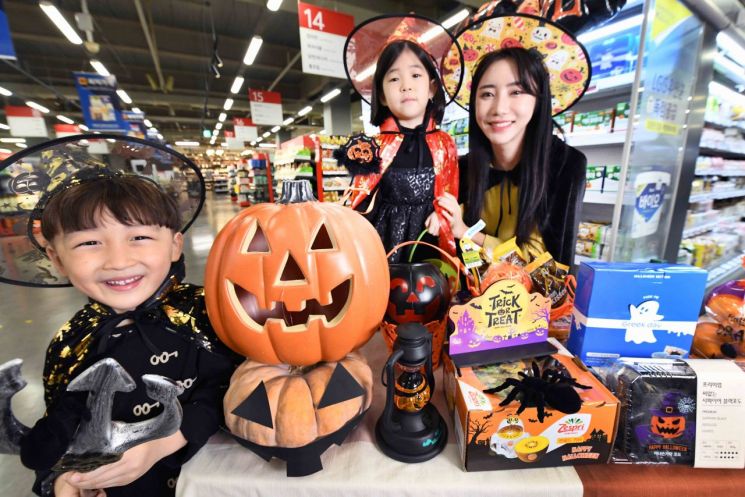 Models at Homeplus are wearing Halloween costumes and introducing event products. (Photo by Homeplus)
[Asia Economy Reporter Jeon Jinyoung] Public opinion on Halloween remains divided into two camps. While some view it as an established festival, there are still unfavorable views questioning why people should spend money on a Western festival that is not a traditional Korean holiday.
Looking at the prices on Gmarket and Auction for Halloween costumes as of the 25th, the cheapest start at around 20,000 won, while famous characters like Hulk and Captain America command prices in the 80,000 to 100,000 won range. Considering various accessories, interior decorations, and candies exchanged during Halloween, the preparation cost easily exceeds 100,000 won. At a time when prices are already rising, there are criticisms that this only encourages overspending.
On the other hand, there is also a perspective that Halloween should now be recognized as a form of play culture, like a festival. In fact, Halloween has begun to be seen as a fun event by generations not accustomed to costume culture. Shopping centers and major downtown areas change their decorations for Halloween, and with the increase in various events, it provides consumers with another unique experience.
Experts analyze that through this public opinion divide, Halloween is gradually expanding as a familiar culture across multiple generations, but they emphasize that the original meaning of Halloween should be focused on to prevent cultural consumption from leading to alienation or conflict among some generations.
Professor Lee Eunhee of Inha University’s Department of Consumer Studies said, "Halloween used to be a festival shared only by a few with overseas experience, but now it has spread to quite a few generations and has become an annual event that consumers accept more naturally than before." However, she expressed concern that "when a culture unfamiliar to all generations is introduced, some generations, such as the elderly, may still feel it is strange."
She added, "Because people have accepted only the outward appearance of Halloween as a peculiar culture of wearing masks or costumes rather than its meaning, this rejection by some generations appears. Meaningful consumption requires time to contemplate and share the meaning and essence of Halloween."
Professor Song Jaeryong of Kyung Hee University’s Department of Sociology also noted, "The core group that enjoyed Halloween in the past?mid-teens to early twenties?have become parents in their thirties raising children, which has resulted in the spread of the culture." However, he pointed out, "This phenomenon inevitably involves commercial capitalist marketing strategies by companies aiming to capitalize on the Halloween boom."
He added, "For Halloween to become an event that gains empathy from all generations, it must go beyond a simple one-time event and be accompanied by cultural forms. Sufficient time is needed for everyone to accept it."
© The Asia Business Daily(www.asiae.co.kr). All rights reserved.