2022 KIC Conference
'DTx, Clinical and Pharmaceutical Industry'
Kang Sungji "DTx Must Advance Toward Precision Medicine"
Nam Byungho "DTx Different from Drugs and Medical Devices, Clinical Attention Needed First"
Kwon Sohyun "DTx, Revolutionary Opportunity for Pharmaceutical Companies"
[Asia Economy Reporter Chunhee Lee] As the first domestic digital therapeutic (DTx) is expected to receive approval from the Ministry of Food and Drug Safety within this year at the earliest, a forum was held to explore ways to foster growth in the DTx industry.
According to the related industry on the 17th, at the '2022 KoNECT International Conference (KIC)' held on the 14th at the Conrad Hotel in Yeongdeungpo-gu, Seoul, jointly hosted by the National Clinical Trial Support Foundation, the Ministry of Health and Welfare, and the Ministry of Food and Drug Safety, various discussions were held on the current status of the domestic DTx industry, clinical trials, and development cooperation under the theme 'DTx, Clinical Trials, and the Pharmaceutical Industry.' Kang Sung-ji, CEO of Welt, who is currently developing the DTx 'PillowRx'; Nam Byung-ho, CEO of Herings, who founded the DTx development company after conducting clinical research activities; and Kwon So-hyun, CEO of InnoCube, who leads open innovation based on a pharmaceutical company, diagnosed the current DTx business and simultaneously suggested directions to move forward.
Moving Beyond 'Digitalization' to 'Digital Transformation'... DTx Dreaming of 'Precision Medicine'
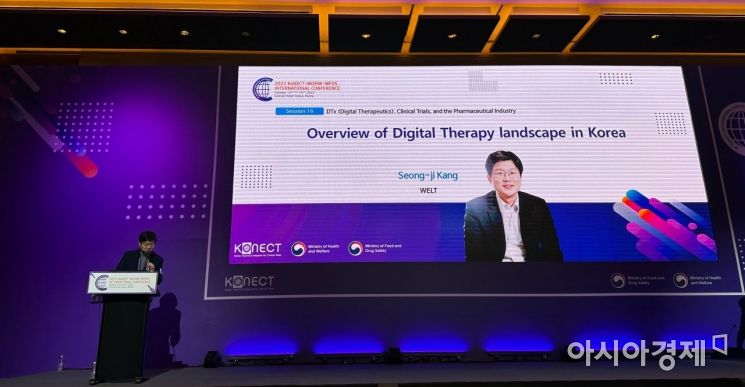 At the '2022 KoNECT International Conference (KIC)' jointly hosted by the National Clinical Trial Support Foundation, the Ministry of Health and Welfare, and the Ministry of Food and Drug Safety at the Conrad Hotel in Yeongdeungpo-gu, Seoul, Kang Sung-ji, CEO of Welt, is giving a lecture on the topic of 'Overview of the Current Status of Digital Therapeutics in Korea.' / Photo by Lee Chun-hee
The first speaker, Kang Sung-ji, CEO of Welt, emphasized in his lecture titled 'Overview of Digital Therapy Landscape in Korea' that "'Digitalization' and 'Digital Transformation' must be distinguished." He pointed out that "DTx is an evolving therapy" and "it should not be limited to merely digitalizing existing solid treatment processes." He stressed the need to consider better treatments beyond simply digitalizing existing therapies such as cognitive behavioral therapy (CBT).
As one of the measures for this, CEO Kang noted that DTx should be commercialized based on clear differences while utilizing existing digital devices such as smartphones. This is because it can become a device that precisely targets patients with specific diseases. He said, "Although all related data already exist on smartphones, some data are unused because they target healthy people, not patients. If the user is an insomnia patient, the smartphone should record the history of turning it on to check the time after waking up and confirm visits to cafes not only through expense management apps but also regarding health." Through this, it should advance to 'precision medicine' that can verify data needed by actual medical staff and even perform pre-screening.
Reflecting on the history of the domestic DTx industry, CEO Kang also self-assessed that the industry has recently grown rapidly. He said, "When Welt joined the Digital Therapeutics Alliance (DTA) a few years ago, there were no members from the Asia region," but viewed the announcement of the 'Digital Therapeutic Device (DTx) Approval and Review Guidelines' by the Ministry of Food and Drug Safety in 2020 as a turning point that laid the foundation through various supports and institutional advancements.
DTx Clinical Trials Different from Conventional Drugs and Medical Devices... Careful Setting of Control Groups Needed
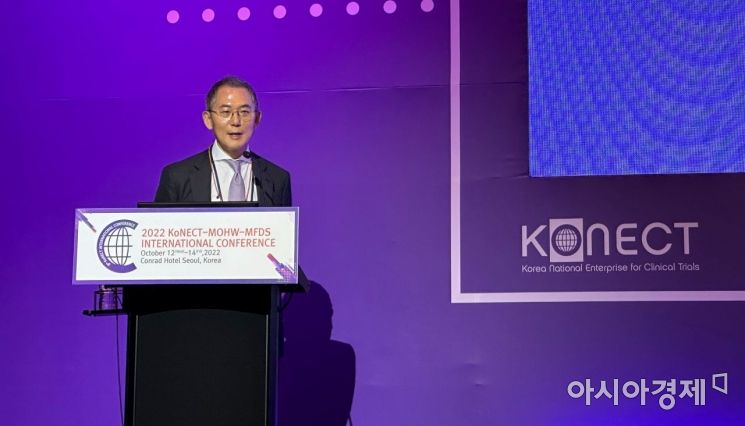 At the '2022 KoNECT International Conference (KIC)' jointly hosted by the National Clinical Trial Support Foundation, the Ministry of Health and Welfare, and the Ministry of Food and Drug Safety at the Conrad Hotel in Yeongdeungpo-gu, Seoul, Nam Byungho, CEO of Herings, is giving a lecture on the topic of 'Considerations in DTx Clinical Design.' / Photo by Lee Chunhee
Next, Nam Byung-ho, CEO of Herings, emphasized in his lecture titled 'Design Considerations for Clinical Trials in Digital Therapeutics' that "effectiveness must be proven through well-designed clinical trials" and stressed that "no matter how good a drug or medical device is, it cannot enter the market if this is not the case." Before founding Herings, CEO Nam was active in clinical research as a health statistician, serving as a professor at Boston University in the U.S. and as head of the Clinical Research Cooperation Center at the National Cancer Center.
CEO Nam mentioned that special attention should be paid to setting the 'control group.' Typically, placebos, no-treatment, and dose-response are used as control groups in clinical trials, but since DTx is a software medical device (SaMD) and differs from conventional drugs or hardware medical devices, careful consideration is needed in control group settings.
He cited the 'active/positive' group as one of the most commonly used control group settings in DTx. This clinical design method is used to prove that a new therapy is superior to existing treatments. CEO Nam explained, "It is a method of setting the standard treatment as the control group and adding DTx to see if the therapeutic effect can be enhanced," adding that "it is free from ethical issues." According to him, Pear Therapeutics' 'RESET' and Big Health's 'Sleepio,' which have already succeeded in DTx clinical trials, also proved efficacy through this design.
DTx as a New Opportunity for Pharmaceutical Companies... "DTx Developers Should View from the Pharmaceutical Companies' Perspective"
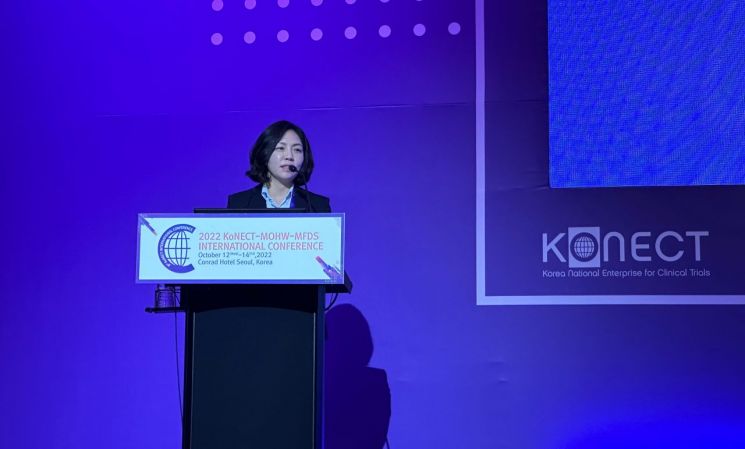 At the '2022 KoNECT International Conference (KIC)' jointly hosted by the National Clinical Trial Support Foundation, the Ministry of Health and Welfare, and the Ministry of Food and Drug Safety at the Conrad Hotel in Yeongdeungpo-gu, Seoul, Kwon Sohyun, CEO of InnoCube, is giving a lecture on the topic of 'Collaboration Strategies Between Pharmaceutical Companies and DTx Developers.' / Photo by Lee Chunhee
Lastly, Kwon So-hyun, CEO of InnoCube, who gave a lecture titled 'Strategies of Business Cooperation between Pharmaceutical Industry and DTx Companies,' informed that DTx can be a new opportunity for pharmaceutical companies. Since January, CEO Kwon has been leading InnoCube, a bio-venture accelerating subsidiary of Handok, one of the major domestic pharmaceutical companies. Having worked in business development (BD) at Handok for over ten years, she also led a 3 billion KRW investment by Handok in Welt last year.
She said, "DTx is evolutionary in terms of research and development (R&D), clinical trials, regulation, and reimbursement for pharmaceutical companies, and revolutionary in commercialization." She added, "Since DTx ultimately aims to establish a patient-centered business and medical environment, this is a revolutionary aspect for pharmaceutical companies." Regarding economic value, she also said, "DTx can extend the life of expired drugs through additional therapies such as monitoring," and "DTx offers many opportunities as it allows continuous patient engagement, such as real-time patient monitoring."
CEO Kwon also emphasized the significant advantages of cooperation with pharmaceutical companies for DTx developers. She said, "DTx is not a business-to-consumer (B2C) transaction. Since drugs must go through medical professionals and be verified, working with experienced pharmaceutical companies will enable more effective market entry." She did not forget to give advice to DTx developers, emphasizing, "They must understand the needs of pharmaceutical companies" and "speak from the pharmaceutical companies' perspective." She explained that it is necessary to clearly define which disease the DTx targets and to continue efforts to coexist with pharmaceutical companies' vision.
© The Asia Business Daily(www.asiae.co.kr). All rights reserved.