1994 Food Sanitation Act Violations in 5 Years
127 Cases in First Half of This Year... CU Tops Violation Count
Expired Products and Pricing Most Frequent
Sanitation Authorities and Headquarters Need Education and Inspections
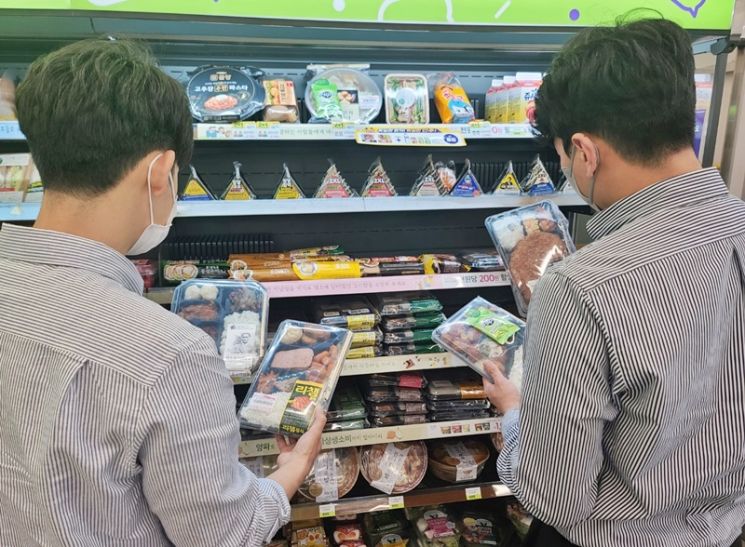
[Asia Economy Reporter Lim Chun-han] As lunch inflation (lunch + inflation) intensifies, more people are relying on convenience stores for meals, but gaps in food hygiene management are being exposed. With frequent violations of the Food Sanitation Act occurring every year, there are growing calls for strengthened inspections and regulations at both the government and convenience store headquarters levels.
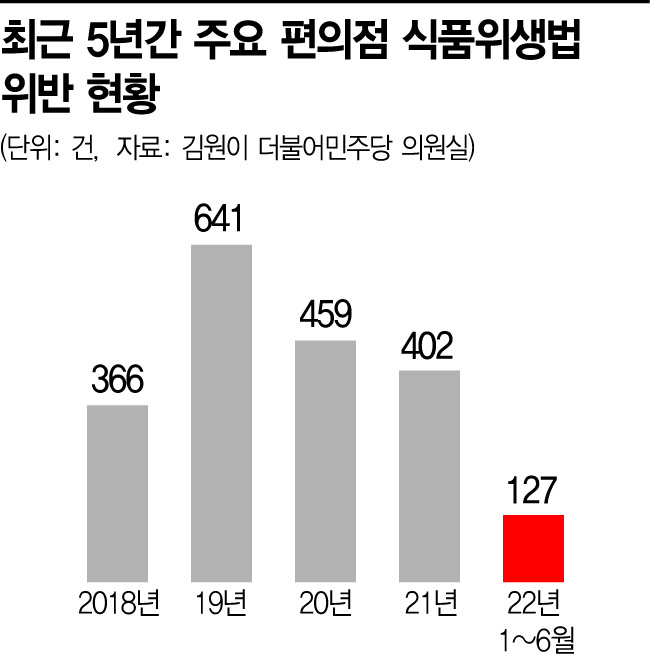
According to data on 'Convenience Store Food Sanitation Act Violations' submitted by the Ministry of Food and Drug Safety to the office of Kim Won-i, a member of the National Assembly's Health and Welfare Committee from the Democratic Party of Korea, a total of 1,994 violations occurred at major convenience stores over the past five years, averaging 388 cases annually. By year, there were 366 cases in 2018, 641 in 2019, 459 in 2020, 402 in 2021, and 127 cases from January to June this year.
By type, violations of hygienic handling standards, mainly involving storage and sale of expired products, accounted for 52.9%, and failure to complete hygiene education, a potential hygiene risk factor, accounted for 28.5%. This was followed by unauthorized disposal (12.8%), failure to undergo health examinations (2.2%), and violations of business operator compliance requirements (1.3%). By company, over the past five years, GS25 recorded 626 cases (32.2%), CU 558 cases (28.7%), Seven Eleven 504 cases (25.9%), Emart24 162 cases (8.3%), and Korea Ministop 144 cases (7.4%). As of the first half of this year, CU had 45 violations, Seven Eleven 32, GS25 28, Emart24 15, and Korea Ministop 7, in descending order of violation counts.
Currently, convenience stores are focusing on expanding ready-to-cook foods beyond simple meals like triangular gimbap and sandwiches. CU and GS25 sell chicken, fried foods, and fish cakes at about 7,000 stores each, Seven Eleven at about 5,000 stores, and Emart24 at about 200 stores. Convenience store headquarters claim to be making every effort to manage food hygiene.
Each company uses time barcodes for ready meals, preventing scanning of expired products at the checkout. A system is in place to block sales at the source. For chicken, they manage manufacturing and shelf life registration, provide guidance on personal hygiene and equipment cleanliness, and monitor acid values. Store owners are given personal hygiene management sheets and store hygiene checklists to check daily inspection items. However, given that convenience stores are mainly operated by part-time workers, conditions vary significantly by store.
Although convenience stores receive fines every year, violations of the Food Sanitation Act are repeated, highlighting the need for continuous education and inspections by hygiene authorities and convenience store headquarters. Assemblyman Kim said, "As high prices increase the popularity of convenience stores as an easy meal option among office workers and students, hygiene issues are also emerging," adding, "To provide safe food to the public, meticulous hygiene management by food companies and thorough investigation and inspection by the Ministry of Food and Drug Safety are necessary."
Professor Kim Si-wol of Konkuk University's Department of Consumer Studies said, "With the lifting of social distancing and high prices combined, the number of people using convenience stores at lunchtime has increased significantly, so thorough hygiene management is essential," and added, "Education for headquarters, store owners, and part-time workers, as well as strengthened government regulations, also seem necessary."
© The Asia Business Daily(www.asiae.co.kr). All rights reserved.