Integrated Information on Congestion, Public Transportation, and Remaining Parking Spaces at Major Locations such as Tourist Zones, Key Commercial Areas, and Parks
Released on the Open Data Plaza for Use by Citizens and Domestic and Foreign Tourists
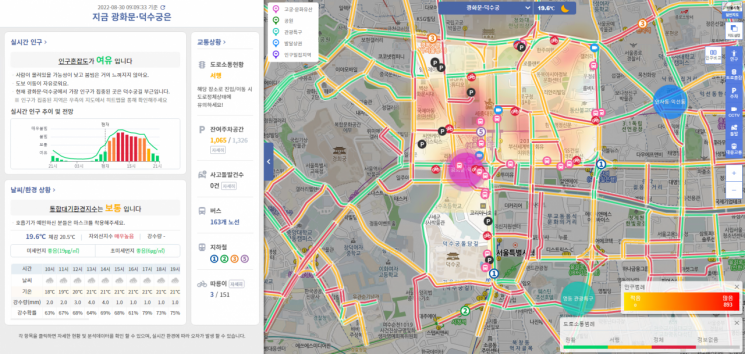
[Asia Economy Reporter Lim Cheol-young] The Seoul Metropolitan Government announced on the 1st that it has developed the ‘Seoul Real-Time Urban Data,’ which allows users to view real-time information of 50 major locations in Seoul, including tourist spots, parks, and key commercial areas, at a glance, and will release it through the Seoul Open Data Plaza.
‘Seoul Real-Time Urban Data’ is a dataset that integratively displays real-time information such as population congestion levels at the location, public transportation status (bus and subway arrival information, remaining Ttareungyi bikes), remaining parking spaces (limited to some parking lots), road traffic conditions, and weather. For population congestion, users can check congestion levels for the past 12 hours through the Open Data Plaza, as well as predicted congestion levels for the next 12 hours based on artificial intelligence (AI). The development was carried out in collaboration with the AI specialist company Whitescan.
The Seoul Metropolitan Government will provide the ‘Seoul Real-Time Urban Data’ service for citizens and domestic and international tourists visiting Seoul, and at the same time, open it as an open API so that anyone, including private companies and developers, can utilize it to create new services. By using the open data, real-time information can be provided through various platforms such as map apps, AI speakers, and public transportation screens, or combined with technologies like metaverse and VR to deliver population, traffic, and weather information in a realistic manner.
Going forward, Seoul plans to utilize the real-time urban data in various administrative fields such as COVID-19 prevention, tourism guidance, and park management to enhance on-site response capabilities. Lee Hye-kyung, Director of Digital Policy at the Seoul Metropolitan Government, said, “We expect that the newly opened ‘Seoul Real-Time Urban Data’ will be usefully utilized by citizens and tourists alike, and that it will meet technology to be developed into new services, providing differentiated urban services.” She added, “Seoul will continue to support IT developers through real-time data collection and opening, and do its best to perform scientific administration based on faster data.”
© The Asia Business Daily(www.asiae.co.kr). All rights reserved.