Highest Growth Rate in Past 5 Years
Violent Crimes Account for 74%
Attributed to COVID-19
"The State Must Actively Care"
[Asia Economy Reporter Oh Gyumin] “My younger sister is not breathing.” On the 24th of last month, Kim (36), who lives in Eunpyeong-gu, Seoul, reported this to the police. When the police responded to the call, the younger sister was already deceased. At the time of discovery, she was emaciated and showed signs of physical abuse. It was later revealed through police investigation that Kim had abused his sister for over a year, leading to her death. He reportedly stated that “he starved and beat her out of frustration because she could not control her bladder and bowels.” They were recipients of basic living subsidies and lived on about 1.6 million KRW per month. Kim was ultimately arrested and sent to prosecution on the 2nd on charges including abuse resulting in death.
On the 12th of last month, a man in his 40s was sentenced to seven years in prison for indiscriminately assaulting his elderly parents because they did not visit him while he was incarcerated. He was tried for repeatedly hitting his 80-year-old father’s head with a cooking pot and grabbing and throwing his 70-year-old mother by the hair at his home in Deokjin-gu, Jeonju, in April.
It has been revealed that nearly 50,000 people have committed crimes against relatives living with them. This is the highest figure since the police began compiling related statistics in 2011. The increase is attributed to more time spent at home due to COVID-19 and changes in family culture.
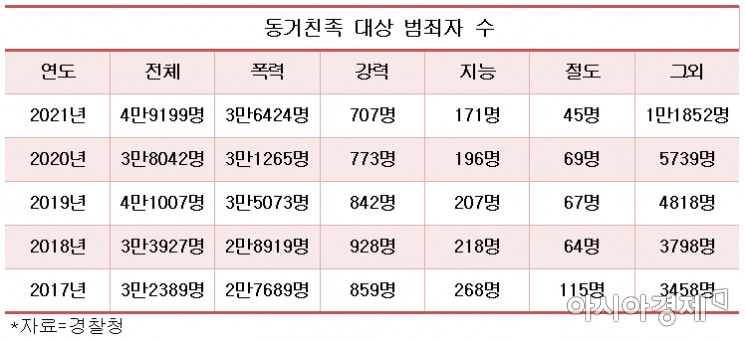
According to the Police Agency’s ‘2021 Crime Statistics,’ 49,199 people committed crimes against cohabiting relatives last year. This is a 29.3% increase from 38,042 in 2020. This is the highest year-on-year growth rate in the past five years (2017?2021). Looking at the recent five years, the number started at 32,389 in 2017 and first exceeded 40,000 in 2019 with 41,007 cases.
Crimes against cohabiting relatives ranked third among crimes where the victim’s identity was known. The total number of criminals last year was 1,247,680. Among them, crimes against cohabiting relatives accounted for 3.9%. Crimes against others accounted for the largest share at 32.2% (402,140 people). Crimes against unidentified victims followed at 29.6% (369,052 people), and crimes against the state accounted for 15% (187,233 people), ranking third overall.
By crime type, violent crimes (such as injury, assault, and confinement) accounted for 36,424 cases, making up 74%. Other crimes and serious crimes followed. Among violent crimes, assault had the highest number of suspects at 24,474.
The number of suspects who committed sexual crimes against cohabiting relatives has been declining over the past five years. It was 504 in 2017 and 543 in 2018, maintaining the 500s, then dropped to 476 in 2019, entering the 400s. It further decreased to 449 in 2020 and 414 last year.
The increase in crimes against cohabiting relatives is attributed to COVID-19. A police official stated, “Although the total number of crimes decreased significantly last year due to COVID-19, the increase in time spent at home likely caused a slight rise in crimes against cohabiting relatives.”
Experts say the changed family culture is reflected in these statistics and that the government needs to take proactive measures to address the causes of crimes among relatives. Seung Jaehyun, a research fellow at the Korea Institute of Criminology and Justice Policy, said, “According to routine activity theory, conflicts within the household are more likely to arise the longer people stay together. As generations change, family culture has also changed, so it is time to foster a family culture that respects each other’s lives.” He added, “Many crimes among relatives also occur due to financial difficulties or conflicts arising from family support processes, so the state must actively care for these issues.”
© The Asia Business Daily(www.asiae.co.kr). All rights reserved.