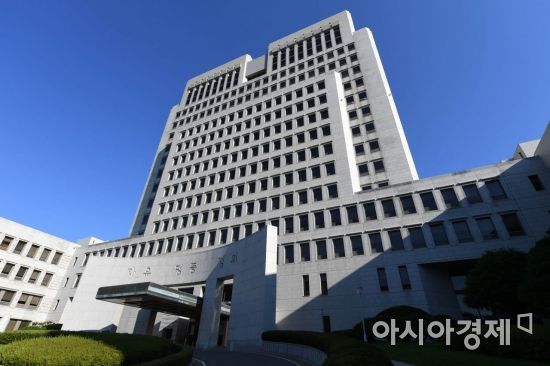
[Asia Economy Reporter Kim Hyung-min] The Supreme Court has ruled that a penalty agreed upon to secure the fulfillment of an obligation (liquidated penalty) must be distinguished from a predetermined amount of damages to be paid by the breaching party to the other party (liquidated damages).
On the 21st, the Supreme Court en banc dismissed A's appeal and upheld the lower court's ruling partially in favor of B in a damages claim lawsuit filed by A, who provided a golf practice building, against B, who installed the practice facility.
In May 2014, A and B entered into a joint business contract where A provided the 9th floor of a building, and B installed the golf practice facility at his own expense. The contract included a clause stating that "separate from damages, in case of non-fulfillment of obligations, the party failing to fulfill the obligation must pay an additional 1 billion KRW." Later, A requested changes to the joint business contract, but B refused. In response, A restricted internet and other communications at the construction site where B was carrying out the golf practice facility construction in October 2014. B halted the construction, and both A and B filed lawsuits against each other, claiming that the joint business contract should be terminated due to the other's fault and demanding the contract penalty of 1 billion KRW.
The first and second trials recognized A's fault in demanding changes to important terms of the existing contract that were disadvantageous to B compared to before, regarded the 1 billion KRW penalty agreement as a liquidated penalty, and did not allow any reduction. However, the second trial only recognized set-off against A's damage claim, ruling partially in favor of B.
The majority of the Supreme Court justices held that a liquidated penalty is a sanction for breach of obligation, voluntarily agreed upon by the breaching party to pay the other party, and therefore, under the principle of private autonomy, the parties' intentions should be respected to the greatest extent possible.
They also added that the broader the court's intervention in liquidated penalties is recognized, the more the function of the liquidated penalty to secure the performance of obligations inevitably weakens, so court intervention should not be easily permitted.
© The Asia Business Daily(www.asiae.co.kr). All rights reserved.







![15-Year Veteran Field Mechanic Becomes AI Talent... Korean Air's Experiment [AI Era, Jobs Are Changing]](https://cwcontent.asiae.co.kr/asiaresize/319/2025121111232252273_1765419802.jpg)