2 Million Foreign Residents Era: The 'New Korean Dream'
Foreigners Account for 4% of Total Population
Over 5% Classified as a 'Multicultural Nation'
Purpose Beyond Missionary Work or Business: Realizing Dreams
Major Players in Real Estate and Financial Investment
Rising "K" Soft Power Overseas
Korea Ranks 2nd in Power Passport Index
Foreign Policy Still in Early Stages
Integrated Immigration Policy Needed for Coexistence
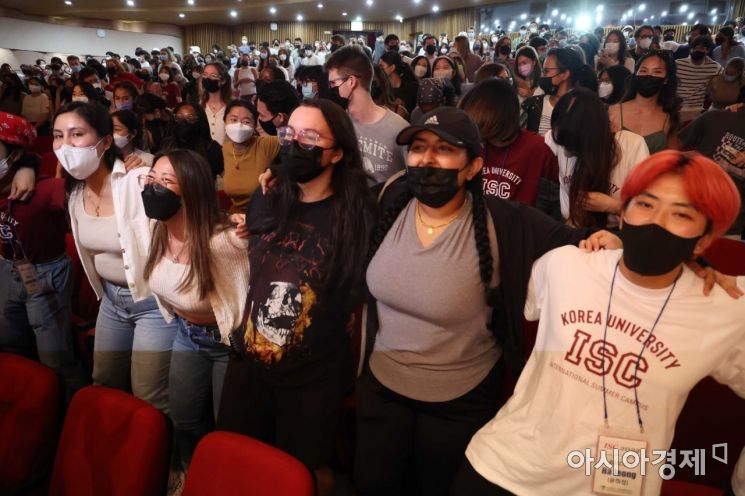 On the 28th, foreign students are learning cheers at the International Summer University entrance ceremony and orientation held at Inchon Memorial Hall, Korea University, Seongbuk-gu, Seoul. Photo by Moon Honam munonam@
[Asia Economy Reporter Kim Hyung-min] Jonathan Tona Yombi (22), who frequently appears on broadcasts, is a 'refugee' from the Democratic Republic of the Congo. His father entered Korea in 2002 and was recognized as a refugee by the court in 2008, so Jonathan has settled and lived in Korea since he was nine years old, in places like Incheon and Gwangju. He is fluent in French, English, and Korean. In 2019, he was admitted to the Department of Political Science and Diplomacy at Hankuk University of Foreign Studies. In January, he decided to naturalize as a Korean citizen and is currently undergoing the naturalization process. Fabian Yves Jerome Corbino (34), a French actor and model, is also a Korean permanent resident. He has already settled in Seoul for 15 years. He has shown himself shopping for the Korean national football team’s uniform, going to the bank to submit his permanent residency card, and opening a housing subscription savings account. Foreigners entering the real estate market, once exclusive to locals, are increasing, buying houses and land and acting as major investors in the financial sector. Foreign workers are also expanding from manufacturing to ICT, gaming, startups, and services. This is the emergence of the ‘New Korean Dream.’ While the previous Korean Dream involved stays for missionary work, business, or labor, the New Korean Dream is about realizing one’s own dreams in Korea through short- and long-term stays and even becoming Korean.
Looking at various statistics and indicators, the New Korean Dream is taking shape. As of May, the number of foreigners residing in Korea is 2.01 million. Since crossing the 2 million mark in 2016, excluding variables such as COVID-19 (1.96 million in 2021), the trend has been gradually increasing. This accounts for 4% of the total population. It is close to the OECD’s multicultural and multiethnic country standard (5% or more). Although China, Vietnam, and Thailand still make up the majority, the soft power of ‘K’ is rising both domestically and internationally. In the global power passport rankings published quarterly by the UK’s Henley & Partners, Korea ranked joint 2nd with Germany. Korean passport holders can visit 190 countries visa-free. Before 2010, Korea was outside the top 10 but has since maintained a top position. Approximately 330,000 people worldwide take the Test of Proficiency in Korean annually, and countries such as Hong Kong, Japan, Vietnam, Thailand, Sri Lanka, Uzbekistan, France, Australia, and New Zealand have adopted Korean for university entrance exams. The US travel community GoOverseas ranked Korean as the third most important language to learn in June, after Chinese and Spanish. However, government policies toward foreigners are still in their infancy, and public opinion on foreigners is mixed.
Former UN Secretary-General Ban Ki-moon recently said at a seminar, "Our country has reached a national crisis due to low birth rates and aging population," and added, "We need to open immigration doors more widely and develop into a global society. Korean society needs to be inclusive toward foreigners residing in Korea." Kim Tae-hwan, Honorary President of the Korean Immigration Policy Association (Professor of Law and Public Administration at Myongji University), said, "Having joined the ranks of the G12 advanced countries and with the rise of the Korean Wave, our national status has risen, making Korea a country where refugees, immigrants, and investors want to come with the ‘New Korean Dream.’ How well we accept and coexist with them will determine sustainable growth."
© The Asia Business Daily(www.asiae.co.kr). All rights reserved.