Electricity fee rises by 5 KRW per kWh... Additional monthly burden of 1,700 KRW for a family of four
KEPCO selling electricity at a loss... May incur a 30 trillion KRW deficit this year
Government criticizes KEPCO's self-rescue measures... "Have they ever returned their salary?"
Public institutions face strong reform warnings... KEPCO insiders say "It's unfair"
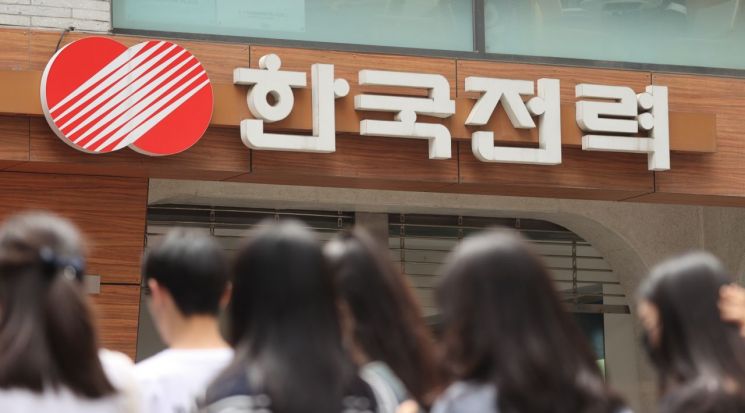 Korea Electric Power Corporation Seoul Headquarters located in Jung-gu, Seoul. [Image source=Yonhap News]
[Asia Economy Sejong=Reporter Lee Jun-hyung] As the government continues its daily 'bashing of Korea Electric Power Corporation (KEPCO),' dissatisfaction among KEPCO employees is growing. Inside KEPCO, reactions such as "Are we the public enterprise's scapegoats?" are emerging. There are criticisms that the government is placing sole responsibility for the 'snowballing deficit' caused by suppressing electricity rate hikes on KEPCO.
According to related ministries on the 2nd, the fuel cost adjustment rate was raised by 5 won per kWh starting from the 1st. The Ministry of Trade, Industry and Energy expects that this increase will raise the average monthly electricity bill for a family of four by 1,535 won. However, including value-added tax (10%) and the electricity infrastructure fund (3.7%), the actual increase in electricity charges is about 1,700 won.
The fuel cost adjustment rate is one of the components of electricity charges and is adjusted quarterly according to fluctuations in fuel costs such as international oil prices. Earlier, on the 27th of last month, the government finalized raising the 3rd quarter fuel cost adjustment rate by 5 won per kWh. Originally, the maximum quarterly increase in the fuel cost adjustment rate was limited to 3 won per kWh. However, the government revised existing regulations and raised the 3rd quarter fuel cost adjustment rate increase to the annual maximum limit of 5 won.
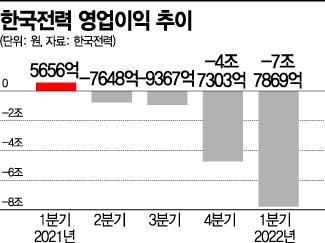
A Deficit of 7.8 Trillion Won in Q1 Alone... Han Duck-soo: "If Private, Would Have Already Bankrupted"
The reason the government significantly raised electricity rates despite high inflation is simple. Due to the Moon Jae-in administration's nuclear phase-out policy, the proportion of expensive energy generation such as liquefied natural gas (LNG) increased, but electricity rate hikes were delayed, causing KEPCO's deficit to balloon uncontrollably. KEPCO already posted a deficit of 7.8 trillion won in the first quarter alone. This figure exceeds last year's total deficit (about 5.9 trillion won), which recorded the largest operating loss in history, by about 2 trillion won.
The problem is that the government strongly criticized KEPCO during the process of raising electricity rates. The government delayed the announcement of the 3rd quarter fuel cost adjustment rate, originally scheduled for the 21st of last month, by nearly a week because it judged KEPCO's self-rescue measures to be insufficient. At a recent press conference held in Paris, France, Prime Minister Han Duck-soo said, "(KEPCO's self-rescue measures) only involve selling existing buildings; they have never once said they would return half their salaries," and added, "KEPCO has only recently, within a few months, done its best in management and had employees make sacrifices as a basic duty." The Prime Minister further stated, "If KEPCO were a private company, it would have gone bankrupt," and added, "If it goes bankrupt, it's not about cutting salaries, but about disappearing altogether."
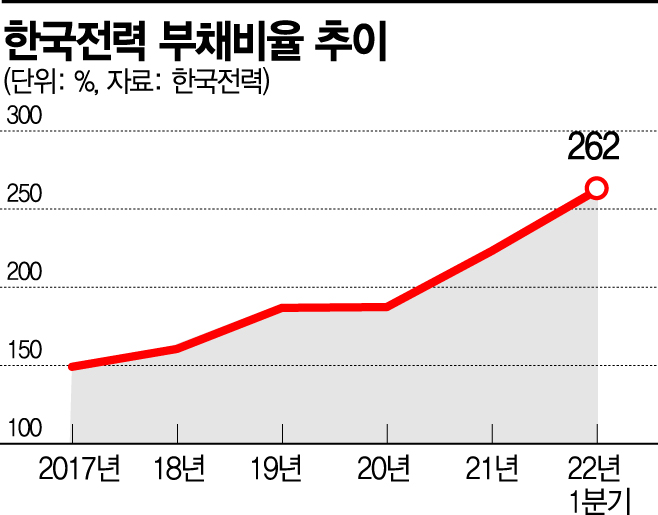
KEPCO Dissatisfaction Rises... Government Announces High-Intensity Reforms
In response, voices of "unfairness" erupted inside KEPCO. It is pointed out that KEPCO's plunge into a 'deficit swamp' is the result of government policies as a public enterprise, yet all responsibility is being shifted solely onto KEPCO. In fact, dissatisfaction within KEPCO can be easily found on the anonymous workplace community 'Blind.' One netizen stated in a Blind post, "Electricity rates are determined by the government or politicians regardless of KEPCO's management environment," and added, "The government controls not only public institution management but also labor costs and welfare, yet it blames all faults on public institutions under the 'reckless management' frame."
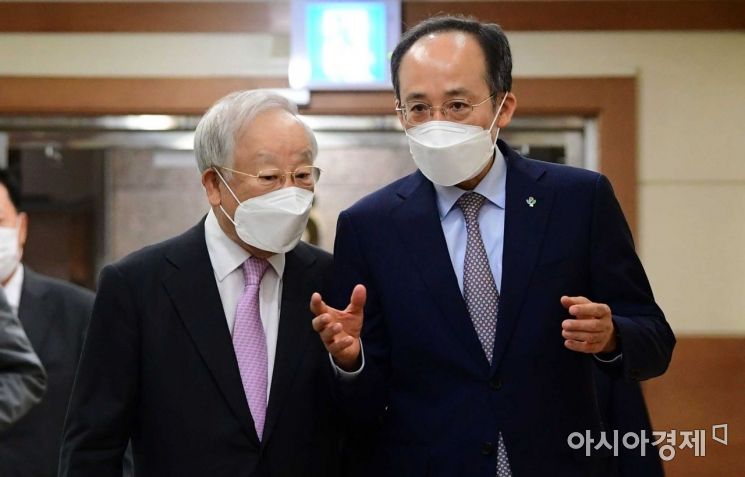 Deputy Prime Minister and Minister of Economy and Finance Choo Kyung-ho and Chairman Sohn Kyung-shik of the Korea Employers Federation are moving to the conference room to attend the "Policy Meeting Invited by the Deputy Prime Minister" held on the 28th of last month at the Korea Employers Federation in Mapo-gu, Seoul. Photo by Kang Jin-hyung aymsdream@
Ultimately, the government chose the path of raising electricity rates, but dissatisfaction within KEPCO is unlikely to subside easily. This is because the government designated KEPCO and 13 other public institutions as 'financial risk institutions' at the end of last month and announced high-intensity reforms. Deputy Prime Minister and Minister of Economy and Finance Choo Kyung-ho recently stated, "The public institution party is over." The government has already demanded that financial risk institutions submit a 'five-year fiscal soundness plan' by the end of this month. They are ordered to prepare financial structure improvement measures such as selling non-core assets and restructuring low-profit businesses.
However, before full-scale public institution reforms, there are opinions that mechanisms to limit excessive government intervention should also be established. This is because there have been many cases where the government's unreasonable policies led to rapid deterioration of public enterprises' financial structures. The rapidly increasing KEPCO deficit is not unrelated to the Moon Jae-in administration's nuclear phase-out policy. The capital erosion of resource public enterprises such as Korea National Oil Corporation resulted from the Lee Myung-bak administration's resource diplomacy policy.
© The Asia Business Daily(www.asiae.co.kr). All rights reserved.