Last Year’s 193,000 Marriages Hit Record Low
Wedding Postponements Surge Due to COVID-19
[Asia Economy Reporter Heo Midam] # Kim (29), a 4-year office worker, sighed at the continuous wedding announcements from acquaintances. He said, "I received wedding invitations three times in the past month alone," adding, "These days, if you give 50,000 won as a congratulatory gift, you feel awkward. Of course, I want to celebrate, but the financial burden of the gift is too heavy." He continued, "Because of the gift money, not attending weddings would make the relationship with acquaintances awkward, so I'm stuck in a dilemma."
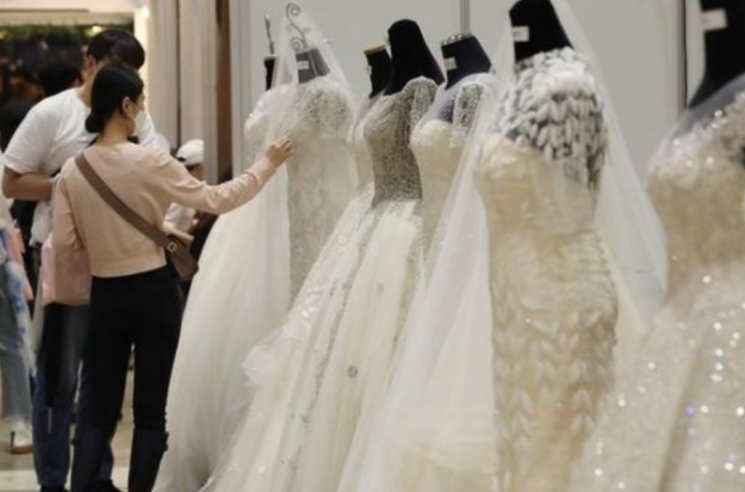
As weddings that were postponed over the past two years due to guest restrictions are now being held in large numbers following the return to normal life, the wedding industry is gaining momentum. However, office workers are expressing concerns about the increased expenses for congratulatory gifts. Some argue that as various family types such as singles and DINKs (dual income, no kids couples) increase, the culture of exchanging congratulatory money should disappear.
Since the lifting of social distancing, demand for weddings among engaged couples has been rising. According to Lotte Department Store, the number of new members in 'Lotte Wedding Members,' a service for engaged couples, increased by about 20% from January to May this year compared to the same period last year, and the average purchase amount per person also rose by more than 30% year-on-year during the same period.
Competition to book wedding venues among engaged couples is also fierce. Most major hotel wedding halls in Seoul, including Gangnam and Mapo, are fully booked until the end of the year. A representative from the Shilla Hotel in Seoul said, "Reservations for wedding halls are fully booked until November, and only the State Guest House is available in December," adding, "The number of weddings has increased compared to last year. The recovery of daily life is likely a factor."
Last year, the annual number of marriages fell below 200,000 for the first time ever due to the impact of COVID-19. According to the '2021 Marriage and Divorce Statistics' released by Statistics Korea in March, the number of marriages last year was 193,000, down 9.8% (21,000 cases) from 214,000 in 2020. This is attributed to factors such as delayed marriage age, a decrease in the marriageable population, and the prolonged COVID-19 pandemic.

However, as more people hold weddings after the return to normal life, some young people are sighing at the flood of wedding invitations. Yang (30), an office worker, said, "Friends who postponed their weddings due to COVID are now getting married one after another," adding, "Since they are close acquaintances, I naturally want to congratulate them, but looking at my living expenses balance, I can only sigh." He continued, "I have no intention to marry yet, so I don't know if I'll have a chance to recover the congratulatory money," and added, "I hope the culture of obligatorily exchanging congratulatory money changes."
Congratulatory money has traditionally served as a kind of mutual aid, celebrating acquaintances' special occasions while exchanging money. However, as singles and DINKs increase, opportunities to recover the money have decreased, leading to resistance. Additionally, soaring prices are a burden for young people. The minimum amount for congratulatory money, usually given in 50,000 won increments, has risen to the 100,000 won range due to inflation and other reasons.
As a result, some young people are choosing not to attend weddings. According to a survey conducted by the matchmaking company Duo on 300 unmarried men and women (150 each), 52.7% of men and 64% of women answered that they do not attend weddings even if they receive invitations. Particularly, 48% of men and 66% of women said they feel burdened when receiving invitations, citing reasons such as "ambiguous relationships" (men 44.7%, women 56.7%) and "financial burden" (men 22.7%, women 16.7%).
Experts say that as diverse family types emerge, the culture of congratulatory money also needs to change. Professor Eunhee Lee of Inha University's Department of Consumer Studies said, "Congratulatory money has traditionally had a strong mutual aid character. However, nowadays, with the increase of singles and diverse family types, it is necessary to consider how to change the culture of congratulatory money so that it does not burden households," adding, "In some foreign countries, gifts are exchanged instead. Ultimately, it is necessary to think about the medium through which good intentions are conveyed."
© The Asia Business Daily(www.asiae.co.kr). All rights reserved.