![[Square] The Future of Korea-Japan Relations: The Business Community Takes the Lead](https://cphoto.asiae.co.kr/listimglink/1/2022060206430289208_1654119782.jpg)
Since the 17th of last month, individuals who have received the third dose of the COVID-19 vaccine are exempt from quarantine upon entering Japan. Starting from the 10th, the entry of foreign tourists, which had been suspended, will also be permitted. Although limited to group tours accompanied by guides affiliated with Japanese travel agencies, this marks a significant change compared to last month when entry was completely prohibited. The governments of both countries are in the final stages of coordinating the resumption of the Gimpo-Haneda route from the 15th. Once the route resumes operation, the air route, which has been suspended since March 2020 due to the COVID-19 pandemic, will reopen. The governments of South Korea and Japan are also discussing visa-free entry for tourists.
The positive momentum for improving Korea-Japan relations following the inauguration of the new government continues. According to a survey conducted by the Korea Chamber of Commerce and Industry (KCCI) in April targeting 327 domestic companies, 45% of respondents answered that "Korea-Japan relations will improve." Compared to the results of the "Corporate Perception of Korea-Japan Relations" survey conducted in October last year, where only 13% of companies expected improvement, this reflects heightened expectations among businesses.
Expectations for improved Korea-Japan relations are also relatively high among Japanese people. Last month, the Mainichi Shimbun reported that in a public opinion poll conducted among Japanese voters, 55% responded that they "expect improvement" in Korea-Japan relations after being informed of President Yoon Suk-yeol's inauguration. This contrasts with a Kyodo News poll conducted on March 19-20, shortly after the South Korean presidential election, where 72.2% of respondents believed that Korea-Japan relations would not change.
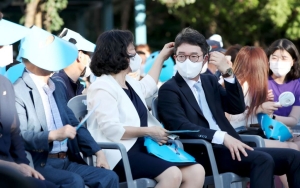
Following the inauguration of the new government, the KCCI held the first Korea-Japan exchange event at the economic sector level on the 11th of last month. They hosted a luncheon meeting with a delegation from the Japan-Korea Parliamentary League, who visited Korea to attend the presidential inauguration. Participants engaged in in-depth discussions on ways to improve Korea-Japan relations and revitalize economic cooperation between the two countries.
South Korea and Japan are neighboring countries not only geographically but also share many similarities in economic and industrial aspects. Both countries are at the forefront of challenges related to low birth rates and aging populations. Last year, Japan's population aged 65 and over accounted for 29.1%, the highest in the world, while South Korea's total fertility rate was 0.81, the lowest globally. Both economies are export-dependent and manufacturing-oriented, facing common challenges such as unstable global conditions and global supply chain crises, exemplified by the Russia-Ukraine conflict. Transitioning to an eco-friendly industrial structure and achieving carbon neutrality are also shared global issues requiring strategic planning.
When countries with many similarities face common issues, cooperation is the best way to find shortcuts to solutions.
At the 53rd Korea-Japan Business Meeting held last November, Choi Tae-won, chairman of the KCCI, proposed establishing a "bilateral economic cooperation platform" between Korea and Japan. For example, addressing the "job mismatch" problem where young people in Korea face job shortages while companies in Japan face labor shortages through the creation of a "Korea-Japan Youth Talent Platform." The idea is for the business communities of both countries to jointly operate employment platforms, increase workforce exchanges, and activate job fairs as practical cooperation measures.
The KCCI holds annual meetings of the Korea-Japan Chamber of Commerce chairpersons, alternating between Korea and Japan. However, these meetings have been suspended since 2018 due to strained Korea-Japan relations and COVID-19. This year, there are plans to resume the Korea-Japan Chamber of Commerce chairpersons' meetings. South Korea is bidding to host the 2030 Busan Expo, while Japan has experience successfully hosting the 2025 Osaka-Kansai Expo. Exchanges between the business communities of both countries will be a valuable opportunity to learn know-how regarding the Expo bidding process.
As time passes, Korea-Japan relations will continue to improve, and visits by key figures to Japan will take place. It is time for active cooperation at the economic sector level. Especially at times like this, the business communities of both countries must take the lead in opening the path for economic cooperation.
Seongwoo Lee, Director of International Trade Headquarters, Korea Chamber of Commerce and Industry
© The Asia Business Daily(www.asiae.co.kr). All rights reserved.






![$29 Monthly Subscription AI Plant Appliance... US Startup Challenges LG [CES 2026]](https://cwcontent.asiae.co.kr/asiaresize/319/2026010819285284553_1767868133.png)