[Asia Economy Sejong=Reporter Son Seon-hee] Last month, the consumer price inflation rate soared to the high 4% range. This is the highest level in 13 years and 6 months since the 2008 financial crisis.
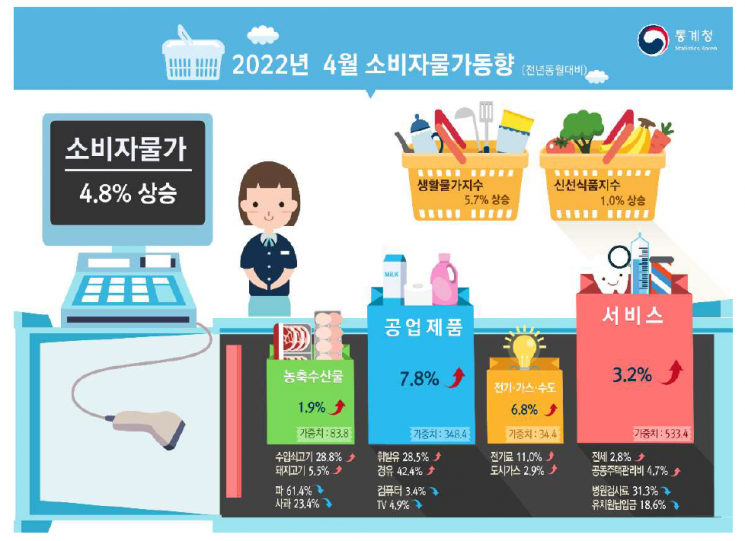
According to the 'April Consumer Price Trends' released by Statistics Korea on the 3rd, the consumer price index last month was 106.85 (based on 2020=100), up 4.8% compared to the same month last year. Not only did the rate of increase expand compared to the previous month, but it is also the highest figure since October 2008, when it recorded 4.8%. This is analyzed as a result of the surge in international energy prices due to Russia's invasion of Ukraine, ongoing global supply chain disruptions since last year, and demand recovery following the lifting of social distancing measures.
The living cost index, composed of frequently purchased items or those with a large expenditure share that are sensitive to price changes, also rose 5.7% to 108.49 compared to the same month last year. This is the highest level in 13 years and 8 months since August 2008, when it recorded 6.6%. This means that the perceived inflation rose even more steeply.
The core inflation rate (excluding agricultural products and petroleum products), which shows the underlying trend of prices, increased by 3.6%. This is the highest since December 2011 (3.6%).
Looking at individual items, industrial products including petroleum products (34.4%) and processed foods (7.2%) rose 7.8% due to the impact of soaring international oil prices. Agricultural, livestock, and fishery products, which had recently seen a slowdown in price increases, also rose 1.9%, mainly driven by livestock products (7.1%).
Following the increase in electricity rates by Korea Electric Power Corporation, prices for electricity, gas, and water rose 6.8%. The inflation rate for electricity prices was 11.0%.
Service prices also rose 3.2%, mainly driven by personal service prices (4.5%). Dining-out prices recorded a high increase rate of 6.6% for the second consecutive month. This dining-out price increase rate is the highest since April 1998 (7.0%).
Oh Woon-seon, Director of Economic Trend Statistics at Statistics Korea, said, "While industrial products such as petroleum and processed foods and personal service prices continued to rise significantly, prices for electricity, gas, and water also expanded their upward trend. The increase rate expanded by 0.7 percentage points compared to the previous month, mainly due to the expanded rise in petroleum and electricity and gas charges."
© The Asia Business Daily(www.asiae.co.kr). All rights reserved.