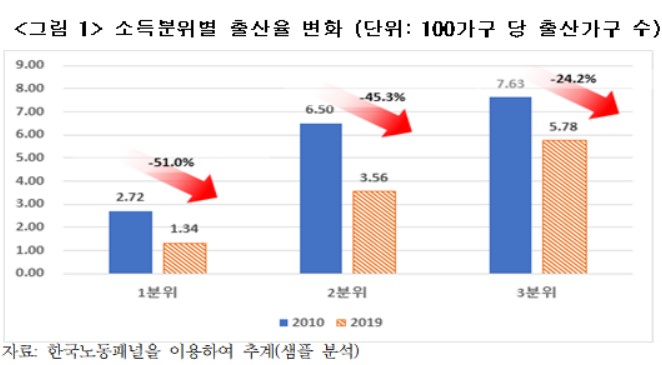
Number of Birth Households per 100 Households by Income Level
Lower Class < Middle Class < Upper Class
[Asia Economy Reporter Park Sun-mi] Over the past decade, the decline in fertility rates among the lower-income groups has been significant, prompting calls for tailored policies targeting low-income households to boost future birth rates.
On the 3rd, the Korea Economic Research Institute reported in its study "Analysis of Fertility Rate Changes by Income Quintile and Policy Implications" that as of 2019, the number of households giving birth per 100 households was 1.34 for the lower-income group, 3.56 for the middle-income group, and 5.78 for the higher-income group.
Analyzing changes in fertility rates by income class from 2010 to 2019 shows the largest decline among the lower-income group. The total number of households giving birth per 100 households across all income groups decreased by 36.2%, from 5.98 in 2010 to 3.81 in 2019. Within this, the fertility rate of the lower-income group dropped by 51.0%, the middle-income group by 45.3%, and the higher-income group by 24.2%.
When limiting the analysis to households giving birth and examining the proportion of households by income class, the share of lower-income households also declined. The proportion of lower-income households among those giving birth fell from 11.2% in 2010 to 8.5% in 2019, and the middle-income group decreased from 42.5% to 37.0%. In contrast, the higher-income group’s share rose from 42.5% to 54.5%.
Analyzing fertility rate changes by educational attainment, divided into low-education groups (high school or below) and high-education groups (college or above), revealed a relatively larger decline among the highly educated. For households with a high school education or less, the number of households giving birth per 100 households was 3.14 in 2019, a decrease of about 11.6% compared to 2010. However, for households with a college degree or higher, the number was 4.12 in 2019, marking a significant decline of approximately 48.1% from 2010.
However, when the Korea Economic Research Institute analyzed fertility rates by income class controlling for factors affecting fertility such as age, education, residential area, and housing type, it found that higher income groups had higher fertility rates. Specifically, the fertility rate was estimated at 3.21 households per 100 for the lower-income group, 5.31 for the middle-income group, and 8.22 for the higher-income group. The fertility rate of the lower-income group was only 39.1% of that of the higher-income group.
Yoo Jin-sung, Senior Research Fellow at the Korea Economic Research Institute, stated, “Since fertility rates are low among the lower-income groups, it is necessary to shift birth policies to focus on supporting low-income households,” adding, “Customized policy support that expands and strengthens aid for low-income or lower-income groups, rather than for higher-income groups, in areas such as childbirth incentives, child allowances, and infant allowances is needed.”
He continued, “While a comprehensive overhaul of social systems may be required to encourage childbirth among highly educated groups, securing work and employment flexibility in the labor market to enable work-family balance is most important,” and suggested, “It is necessary to strengthen promotion and education to foster the perception that household chores and childcare are not exclusively women’s responsibilities.”
© The Asia Business Daily(www.asiae.co.kr). All rights reserved.