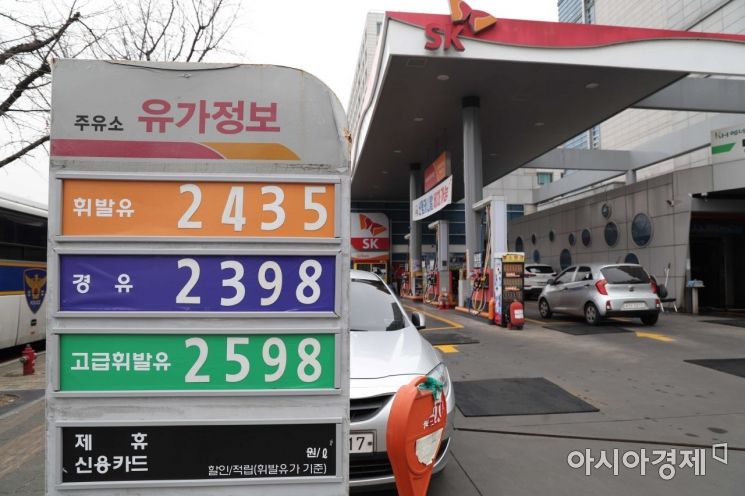
 On the 23rd, gasoline and diesel were being sold at a price well over 2,000 won per liter at a gas station in Seoul.
[Asia Economy Intern Reporter Kim Se-eun] Due to soaring fuel prices, the fuel expenses of general freight drivers are expected to increase significantly this year.
According to the '2021 Freight Transport Market Trend Annual Report' released by the Korea Transport Institute on the 17th, the average monthly fuel expenses of general freight drivers last year were 2.79 million KRW, which is about 260,000 KRW higher than the previous year.
However, considering the rise in oil prices and fuel expenses this year, the monthly expenditure is calculated to be about 3.88 million KRW, which is expected to increase by more than 1 million KRW compared to last year.
The freight transport industry is expressing dissatisfaction, saying that while transportation fees remain the same, the excessive increase in fuel expenses is making it difficult to sustain their livelihoods.
According to the report, the average monthly transportation income (total sales) of general freight drivers last year was 10.05 million KRW, an increase of 660,000 KRW compared to the previous year.
Meanwhile, the average monthly fuel expenses increased by 10.4% to 2.791 million KRW compared to 2.528 million KRW in 2020, and the average annual diesel price at domestic gas stations also rose by 16.9%, from 1,190 KRW per liter in 2020 to 1,391 KRW in 2021.
However, due to the Ukraine crisis and other factors causing fuel prices to skyrocket this year, applying the correlation between the above oil price increase and fuel expense increase to the current oil price results in a monthly expenditure of about 3.88 million KRW. This is 1.09 million KRW more than the previous year's average.
Last month, the average diesel price at domestic gas stations was 1,827 KRW per liter, soaring 25.7% compared to the beginning of the year.
Although the government has decided to provide temporary additional subsidies starting next month, freight drivers have already reached their limits as the high oil price situation has continued for several months.
The government has decided to provide oil price-linked subsidies to transport operators using diesel, such as freight trucks, for three months from May to July, considering the reduction in oil subsidies (oil tax-linked subsidies) due to the fuel tax cut.
Oil subsidies have been implemented since 2001, and oil price-linked subsidies since 2008; these are different subsidy payment systems.
Oil subsidies are provided to alleviate the burden on the transport industry by supporting part or all of the 'increase in fuel tax' as oil subsidies.
Oil price-linked subsidies are a system where the government covers 50% of the excess amount when the diesel price exceeds the standard price of 1,850 KRW per liter (the standard price may vary by region). However, the maximum support limit is capped at 183.21 KRW per liter.
© The Asia Business Daily(www.asiae.co.kr). All rights reserved.