Chinese State Media Reports Xinjiang Uyghur Region's Stable Economic and Social Development Over 5 Years Without Terrorism
US Sanctions on Xinjiang Are Baseless Oppression... Sustained Growth Focused on Agriculture, Solar Energy, and Tourism
[Asia Economy Beijing=Special Correspondent Jo Young-shin] China, which has been condemned by the Western camp including the United States for human rights abuses, reported through Chinese state media that there has not been a single terrorist incident in the Xinjiang Uygur Autonomous Region over the past five years. Despite economic sanctions from the United States and other Western countries, Xinjiang's gross domestic product (GDP) grew by 7% last year compared to the previous year, indicating stable social and economic development.
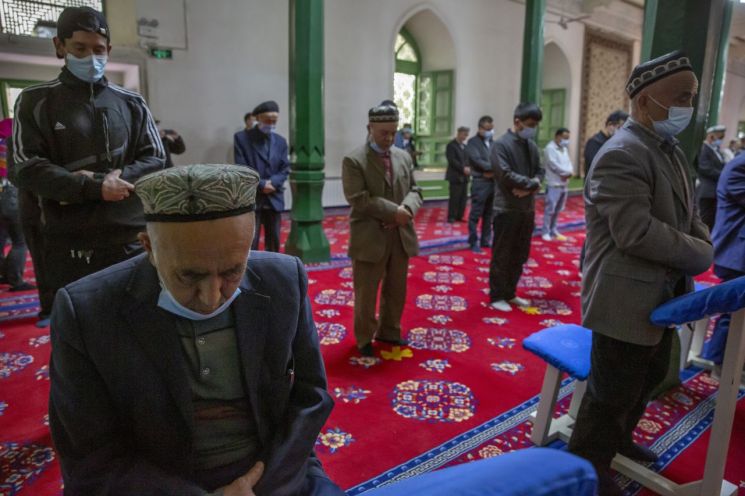
According to Chinese media including the state-run Global Times on the 24th, the Xinjiang Uygur Autonomous Region held the 5th session of the 13th People's Congress the day before and reported that Xinjiang's GDP last year was 1.6 trillion yuan (approximately 301 trillion Korean won).
The Xinjiang authorities also reported that fixed asset investment and regional consumption grew by 15% and 17%, respectively, last year. They added that the urban unemployment rate was managed within the target of 5.5%. Despite U.S. sanctions on Xinjiang enterprises, the value-added output of enterprises above the designated size (large enterprises) was emphasized to be 456 billion yuan (approximately 86 trillion Korean won).
The Xinjiang authorities then set this year's economic growth target for the Xinjiang region at "6% or higher." Regarding this, the Xinjiang authorities stated that the target was set higher than other provinces' targets of 5.0 to 5.5%, and that Xinjiang would achieve continuous growth based on social stability. The Xinjiang authorities will report the results of the 5th session of the 13th People's Congress to the central government. The final economic growth target for Xinjiang will be decided at the upcoming Two Sessions (National People's Congress and Chinese People's Political Consultative Conference) scheduled for March.
The Global Times evaluated that despite COVID-19 and U.S. economic sanctions, Xinjiang achieved continuous economic growth last year, and that U.S. economic oppression does not hinder Xinjiang's growth.
Professor Wang Jiang of Zhejiang Normal University said, "Last year's economic growth in Xinjiang shows that Xinjiang is moving in an orderly and steady direction," adding, "Xinjiang's stability means that its economy can grow further in the future." He also mentioned that the Xinjiang Party Secretary was replaced at the end of last year, and Xinjiang will develop more stably.
In December last year, the Chinese leadership appointed Ma Xingrui, a scientist and technical official holding the title of academician at the International Academy of Astronautics (the highest scientific title), as the Party Secretary of Xinjiang. Ma, the new Party Secretary, previously served as Vice Minister of the Ministry of Industry and Information Technology and has been the Governor of Guangdong Province since 2017.
The Global Times reported that immediately after taking office, Secretary Ma visited Urumqi and ordered the modernization of the regional supply chain and improvement of the international business environment. It also reported that new businesses linking Xinjiang's tourism and culture are being planned, with a target of 250 million tourists this year.
The Global Times cited Chinese experts saying that U.S. sanctions on Xinjiang are meaningless and that the Western camp's oppression of Xinjiang will be ineffective. The media noted that Xinjiang's cotton production last year reached 5.13 million tons, accounting for 89.5% of China's total production, maintaining the number one position in China for over 20 years. The Global Times emphasized that this is the result of the Chinese government's agricultural modernization measures.
Additionally, the Chinese government has actively promoted the Belt and Road Initiative in Xinjiang, resulting in a more than 21% increase in China-Europe freight trains passing through Xinjiang last year compared to the previous year.
Gao Lingyun, a researcher at the Chinese Academy of Social Sciences, said, "Despite baseless oppression from a specific country (the United States), Xinjiang is moving in the right direction," and expressed confidence that "Xinjiang's economy will grow centered on agriculture and the solar power industry in the future."
© The Asia Business Daily(www.asiae.co.kr). All rights reserved.