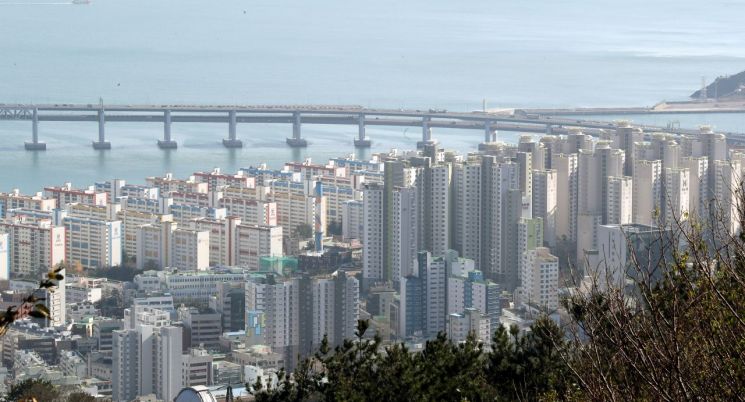
[Asia Economy Reporter Seoyoung Kwon] A large apartment of about 90 pyeong in Haeundae-gu, Busan, has become a hot topic after recording an actual transaction price of 7.5 billion KRW.
According to the Ministry of Land, Infrastructure and Transport's actual transaction price disclosure system on the 21st, on the 18th, a 234.7㎡ unit in Haeundae Gyeongdong Jade, U-dong, Haeundae-gu, Busan, was traded for 7.5 billion KRW. This is an increase of 4.7 billion KRW compared to the price six years ago, as this apartment was traded for 2.78 billion KRW in March 2016. The apartment, which was occupied in November 2012, is an 11-year-old building, with the largest unit size being 103 pyeong (one household), and the 93-pyeong unit traded for 7.5 billion KRW this time is said to be only two households.
As transactions have been rare so far, there is an analysis that the recent rise in apartment prices over the past few years is reflected in this transaction. However, some real estate experts interpret that this case seems very special and difficult to generalize, and that due to the scarcity of listings, transactions can occur at higher prices.
Recently, apartment prices have shown a trend of slowing down nationwide, including Seoul. As of the 17th, the weekly sale price in Haeundae-gu remained steady, and according to the weekly apartment price trend for the third week of January announced by the Korea Real Estate Board on the 21st, the price index for newly built apartments under five years old in the Gangnam area recorded a change rate of -0.02% compared to the previous week.
In fact, for the D.H. Xi Gaepo apartment located in Irwon-dong, Gangnam-gu, which began occupancy at the end of July last year, a 13th-floor unit with an exclusive area of 84.64㎡ was traded for 2.4 billion KRW on the 22nd of last month, which is 700 million KRW lower than the highest price for a similar size unit.
Also, the price of newly built apartments across Seoul fell by 0.01%, marking a decline for two consecutive weeks following the previous week. The market interprets this as a result of the perception that housing prices have peaked, combined with factors such as loan regulations, interest rate hikes, and a wait-and-see attitude ahead of the March presidential election. However, there is also a forecast that large apartments may show strength even in a downward phase of apartment prices due to their limited supply.
© The Asia Business Daily(www.asiae.co.kr). All rights reserved.






![15-Year Veteran Field Mechanic Becomes AI Talent... Korean Air's Experiment [AI Era, Jobs Are Changing]](https://cwcontent.asiae.co.kr/asiaresize/319/2025121111232252273_1765419802.jpg)