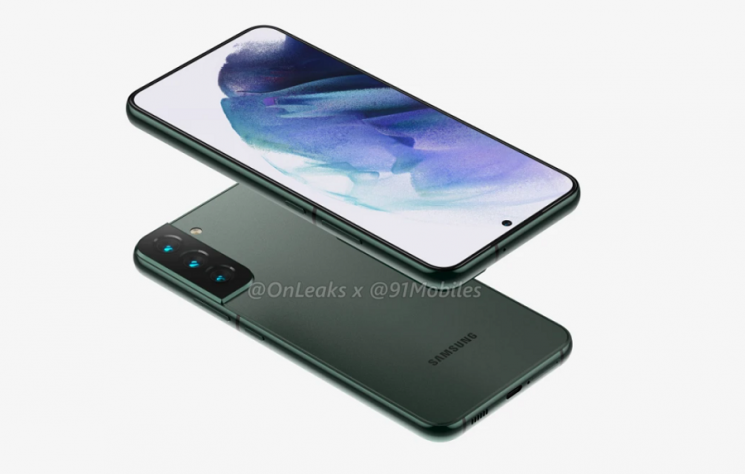
[Asia Economy Reporter Eunmo Koo] There are speculations that the weight of Samsung Electronics' next-generation flagship smartphone, the ‘Galaxy S22’ series, which has been attracting industry attention due to possibilities of integration with the ‘Galaxy Note’ series and an early release in December, will be lighter than its predecessor.
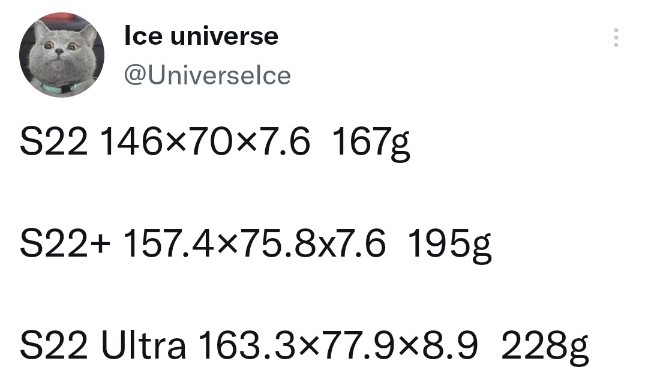
On the 27th (local time), IT specialized media PhoneArena reported, citing famous IT tipster (leaker) Ice Universe, that the weight of the top-tier model in the S22 series, the ‘Galaxy S22 Ultra,’ is 228g.
According to Ice Universe, the weight of the S22 Ultra, which may later be released as the ‘Galaxy Note22 Ultra,’ is expected to be 228g. This is lighter than the previous model ‘Galaxy S21 Ultra (229g),’ which supports ultra-high frequency 5G, as well as Apple’s recently unveiled top-tier model, the ‘iPhone 13 Pro Max (240g).’ However, it is unclear whether this applies to the model supporting ultra-high frequency (mmWave) 5G or only to the version supporting the 6GHz and below (Sub-6) 5G network.
The base models, ‘Galaxy S22’ and ‘Galaxy S22 Plus (+),’ will also be lighter than their predecessors. The S22 weighs 167g, which is 2g less than the ‘Galaxy S21 (169g),’ and the S22+ weighs 195g, which is 5g lighter than the ‘Galaxy S21 Plus (+).’
Earlier, Ice Universe predicted that the size of the S22 series could be smaller than Samsung Electronics’ flagship lineups released in recent years. According to Ice Universe, the screen size of the S22 is expected to shrink to 6.06 inches (15.4 cm). The last time Samsung released a flagship smartphone with a screen smaller than 6 inches was in 2019 with the ‘Galaxy S10e,’ which had a screen size of 5.8 inches (14.7 cm). The sizes of the ‘Galaxy S20’ and S21 base models released afterward were 6.2 inches (15.7 cm).
As the screen size decreases, the battery capacity is also expected to reduce. The estimated battery capacity of the S22 is 3700 milliampere-hours (mAh), which is less than the S21’s 4000mAh. Samsung Electronics is expected to address the negative impact of the reduced battery capacity through improvements in application processors (AP) and other components in the future.
© The Asia Business Daily(www.asiae.co.kr). All rights reserved.