Not Fixed but Maximum Rate... Must Negotiate Before Contract
Check VAT and Keep Cash Receipts for Income Deduction
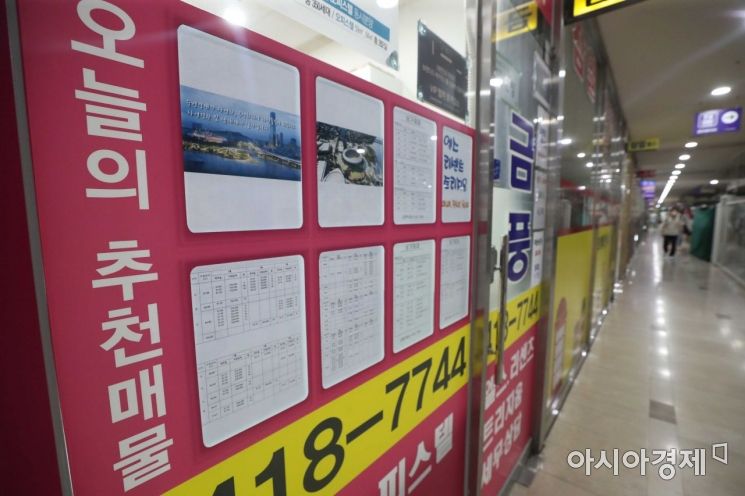 On the 17th, ahead of the real estate brokerage commission reform, property listings are posted at a real estate agency in Songpa-gu, Seoul. Photo by Mun Ho-nam munonam@
As controversies surrounding real estate brokerage fees continue to spread, consumer damage due to information asymmetry remains a concern, requiring caution.
According to the Anti-Corruption and Civil Rights Commission on the 13th, complaints and suggestions related to real estate brokerage fees submitted to the National Petition System over the past two years from 2019 to last year totaled 3,370 cases. With the sharp rise in both sale prices and jeonse (long-term lease) prices, brokerage fees have also skyrocketed, leading to a rapid increase in related disputes.
Experts advise that regardless of the implementation of brokerage fee reform plans, consumers must be aware of several key points to save on fees.
First, the fee rate is not a fixed rate but a maximum rate. For example, the 0.4% rate applied to a 500 million KRW sale transaction results in a brokerage fee of 2 million KRW, which is not a fixed amount but the maximum amount. In other words, consumers and licensed real estate agents can negotiate the fee within this limit.
In practice, most brokers propose brokerage fees at the maximum rate, and consumers mistakenly assume the maximum rate is a fixed rate, paying the amount proposed by the agents without question. Therefore, it is advisable for consumers to negotiate the fee rate with the brokerage office before inspecting the property or signing the contract.
Attention should also be paid to the value-added tax (VAT) on brokerage fees. Recently, Mr. B, who completed a jeonse contract, was told by a licensed real estate agent that "an additional 10% VAT must be paid on top of the fee." Without suspicion, Mr. B paid the 10% to the agent. However, if the agent is a simplified tax business operator rather than a general taxpayer, there is no obligation to pay this. According to tax law, simplified tax business operators are exempt from VAT, so charging consumers for it is clearly illegal.
Additionally, since real estate brokerage fees are eligible for income tax deductions during year-end tax settlements, it is recommended to obtain a cash receipt. Real estate brokerage is a business required to issue cash receipts. If the fee exceeds 100,000 KRW, a cash receipt must be issued. If the brokerage office refuses, it can be reported through the National Tax Service's Hometax system. If a violation is confirmed, a reward of 20% of the unissued amount will be paid.
© The Asia Business Daily(www.asiae.co.kr). All rights reserved.