Ryu Ho-jeong "Tattoo Industry Law Bill Draft Completed"
13 Million Tattooed People in Korea... Practitioners Still 'Criminals'
Tattoo Industry: "Tattooing Is Already Fashion and Culture"
Medical Community: "Legalization Makes Systematic Response to Tattoo Side Effects Impossible"
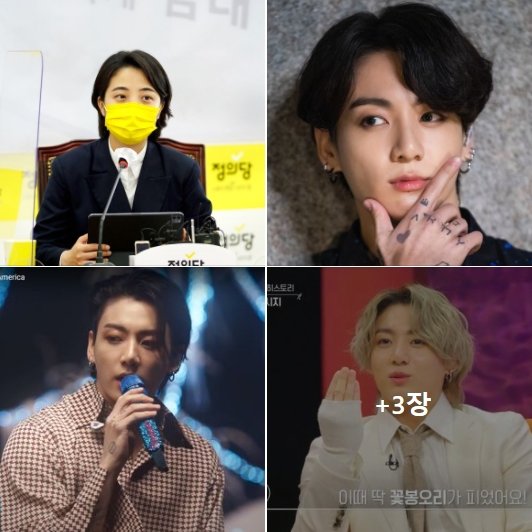
[Asia Economy Reporter Heo Midam] "Take the bandages off BTS's bodies!"
This is the title of a post that Justice Party lawmaker Ryu Ho-jeong uploaded on her Facebook on the 8th. As the demand for tattoo (permanent tattoo) procedures has recently increased, voices calling for the 'legalization of tattoos' are growing louder. Some lawmakers have also proposed related bills, but they still have not passed the National Assembly.
In this situation, the tattoo industry points out that South Korea is the only country that defines tattoo procedures by non-medical personnel as illegal, and argues that legalization would allow both practitioners and consumers to work in a safer environment. On the other hand, the medical community opposes this, saying that tattoo procedures by non-medical personnel could pose a threat to public health.
On that day, lawmaker Ryu posted on Facebook, opening with, "Have you ever seen 'bandages' stuck on the bodies of your favorite celebrities?" and "This ugly sight, frequently seen on Korean broadcasts, is a measure taken by broadcasting stations to cover up 'tattoos.'" She also posted a photo showing BTS member Jungkook covering tattoos on his fingers and back of his hand with bandages.
Lawmaker Ryu pointed out that tattooing is still illegal and criticized, "The 'system' is not keeping up with the world's changes that respect individuals' free personality and creativity."
She continued, "In the era of 3 million tattoo population, while domestic tattoo artists with top skills and high artistry sweep world competitions and are revered as outstanding artists on the global stage, only 'K-Tattoo' is being ignored by KOREA," she criticized.
She stated, "I have completed drafting the 'Tattoo Business Act,'" adding, "It defines tattooing, stipulates licensing requirements and disqualifications, and allows only qualified tattooists to perform procedures at registered establishments. Since it directly affects the public's health rights, the Ministry of Health and Welfare will be the main agency, and tattoo businesses will be given obligations for hygiene and safety management as well as responsibilities to complete related education."
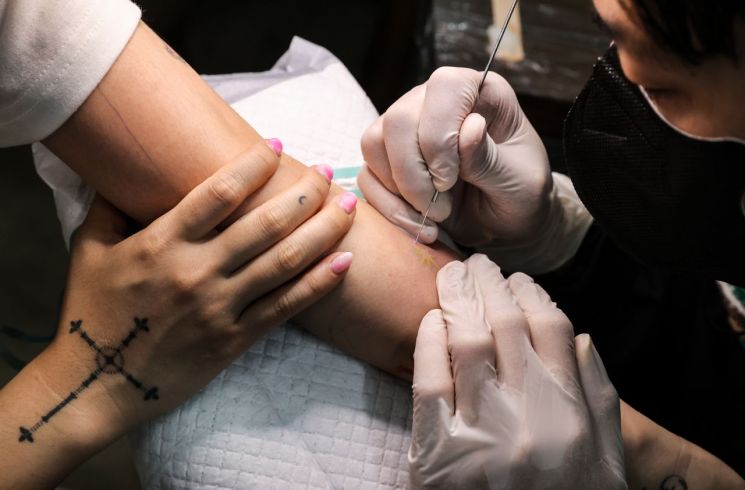 A tattoo artist is working with a needle in a studio in Seoul. The photo is unrelated to specific expressions in the article. Photo by Yonhap News.
As the demand for tattoo procedures increases, the tattoo market size is also growing. According to data released in 2018 by The Standard, a tattoo dye manufacturer, it is estimated that about 13 million people in South Korea have tattoos including semi-permanent and permanent tattoos (10 million semi-permanent tattoos, 3 million full-body tattoos including permanent tattoos). The Korea Tattoo Association also estimated that 6.5 million tattoo procedures are performed annually.
As tattoos have become popularized, social perception has also changed positively. According to a 2018 'Tattoo Perception Survey' conducted by market research firm Embrain Trend Monitor targeting 1,000 adult men and women, 70.9% of respondents said, "Perceptions of tattoos have become much more tolerant than in the past." Also, 52.9% responded that "tattoos are a way to express oneself."
Last year, a 25-year-old university student Lee, who got a tattoo on his wrist, said, "I got my pet dog's face tattooed on my wrist. It's cute, and since my pet dog is like family, I got it so I would never forget." He added, "In the past, tattoos were associated with negative images like gangsters. But now, tattoos have emerged as a means to express individuality. Next, I want to get a lettering tattoo."
Thus, tattoos have established themselves as a means of expressing individuality among young people, but related laws and systems remain stuck in the past. South Korea is practically the only country that defines tattoo procedures as illegal. Under current law, tattoo procedures are legal only if performed by licensed medical professionals; all others are illegal.
Japan also initially defined tattoo procedures by non-medical personnel as illegal, similar to South Korea. However, in September last year, the Japanese Supreme Court ruled that "tattoo procedures are not medical acts," leading most countries except South Korea to allow tattooing and semi-permanent procedures by non-medical personnel.
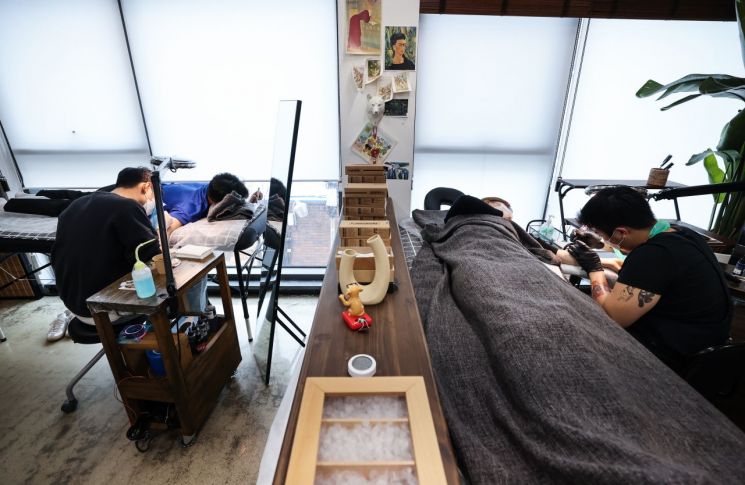 Tattoo artists are working in a studio in Seoul. The photo is unrelated to specific expressions in the article. Photo by Yonhap News
Because tattoos are illegal, punishments against tattoo artists continue. Kim Do-yoon (41), head of the Tattoo Union branch, received a summary order of a 5 million won fine in December 2019 for violating the Medical Service Act by tattooing a celebrity at his tattoo shop in Jongno-gu, Seoul.
He requested a formal trial and on the 28th of last month, in the first trial, he appealed, saying, "My colleagues are artists who chose the human body as a medium for artistic expression," and "What we gained from working hard on our art is a criminal record for violating the Medical Service Act and a broken life."
Earlier, about 60 organizations including the Korea Tattoo Artists Central Association held a press conference in April, stating, "Tattoos other than semi-permanent makeup, which are widespread worldwide and in our society, have already become beauty, fashion, and culture. If we want to prevent side effects and infection risks caused by tattoos and create an environment where young students are safely protected, the Tattoo Artists Act must be enacted promptly."
On the other hand, the medical community maintains opposition to legalization, arguing that allowing tattoos by non-medical personnel could cause infections and allergic reactions due to unhygienic use of equipment.
The Medical Policy Research Institute under the Korean Medical Association stated in a report titled 'Problems of Tattoos (Semi-permanent Makeup) by Unqualified Persons' published last year, "Allowing tattoos by non-medical personnel (tattooists, skin beauticians, etc.) would make systematic responses to tattoo side effects impossible, putting public health at high risk."
It added, "The government and Ministry of Health and Welfare should strictly crack down on illegal tattoo procedures to minimize damage to public health caused by illegal tattooing."
Meanwhile, there are opinions that it is necessary to enact and operate laws including qualifications for tattoo artists, management of establishments, and other regulations related to procedures, as in major advanced countries.
The Korea Institute for Health and Social Affairs suggested in its 2019 report 'Survey on Tattoo Procedure Status and Safety Management Measures' that "Considering that tattoo and semi-permanent makeup procedures are widely performed and have significant public health and hygiene impacts, it is practically necessary to enact laws related to tattoo and semi-permanent makeup procedures to allow them institutionally while ensuring safety."
© The Asia Business Daily(www.asiae.co.kr). All rights reserved.