[Asia Economy Reporter Kim Heung-soon] The market capitalization gap between Taiwan's TSMC and Samsung Electronics, which compete in the global semiconductor market, has widened nearly 12 times over the past year.
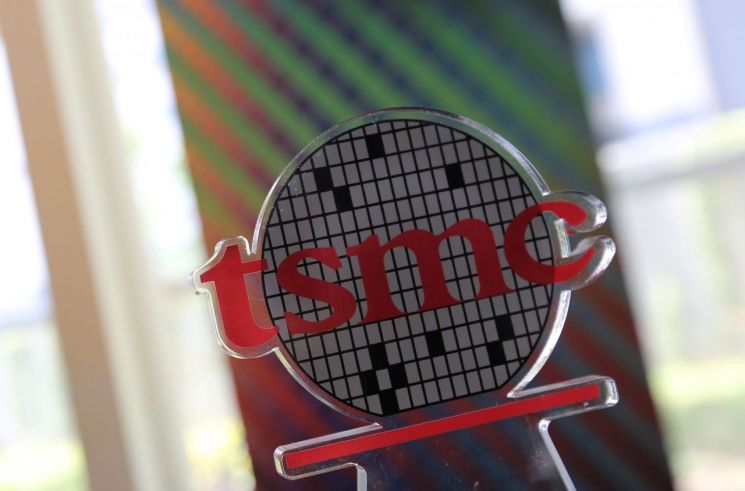
According to an analysis of the market capitalization of the top 10 global semiconductor companies by revenue, based on data from market research firm IC Insights as of the 27th (closing price, converted to US dollars), TSMC's market cap reached $543.293 billion (approximately 605.77 trillion KRW), a sharp increase of 96.3% compared to $276.781 billion a year ago. During the same period, Samsung Electronics maintained its second-place position with a market cap of 475.19 trillion KRW (about $425.42 billion), up 59.5% from a year earlier. The market cap gap between TSMC and Samsung Electronics widened from $10.091 billion last year to $117.873 billion currently. Until two years ago, Samsung Electronics' market cap was more than $10.7 billion ahead of TSMC, but the situation has changed.
TSMC's valuation has risen since the second half of last year following the shortage of system semiconductors, including those for automotive use. In the first quarter of this year, TSMC's revenue was $12.9 billion (about 14.4 trillion KRW), lower than Samsung Electronics' 19 trillion KRW, but its operating profit was $5.36 billion (about 6 trillion KRW), nearly twice that of Samsung Electronics' 3.37 trillion KRW. Last year, TSMC's global foundry market share was 54%, while Samsung Electronics held 17%, widening the gap from the previous year. Recently, TSMC has been strengthening its market dominance by deciding to build six advanced foundry plants in Arizona, USA.
Samsung Electronics also saw its stock price rise above 90,000 KRW early this year, fueled by increased semiconductor demand due to COVID-19, expanded dividend policies, and expectations of a semiconductor supercycle (long-term boom), raising hopes of breaking into the 100,000 KRW range. However, adverse factors such as Vice Chairman Lee Jae-yong's detention and the shutdown of the foundry plant in Austin, Texas, due to a cold wave have caused the stock price to fluctuate around the 80,000 KRW level recently.
The third-largest market cap belongs to US fabless company Nvidia, which recorded $385.579 billion. Nvidia, originally a graphics semiconductor specialist, has recently expanded into central processing units (CPUs) and is the top US semiconductor company by market cap. Its stock price surged 81.8% over the past year, chasing Samsung Electronics. US company Intel, which dropped to fourth place in overall market cap last year after being overtaken by Nvidia, is the only one among the top 10 global semiconductor companies by revenue to see a decrease in market cap over the past year.
US broadband communication semiconductor company Broadcom recorded a market cap of $190.955 billion, up 65.2% over the past year, ranking fifth. Following were Texas Instruments ($174.666 billion), Qualcomm ($150.746 billion), and Micron Technology ($94.12 billion), occupying the 6th to 8th positions respectively.
SK Hynix's market cap increased 54.2% from $53.052 billion a year ago to $81.794 billion, ranking 9th among the top 10 companies by revenue. Taiwan's communication semiconductor manufacturer MediaTek had the lowest market cap among the top 10 at $53.268 billion but surged 100.3% compared to a year ago, achieving the highest market cap growth rate among the top 10 companies.
© The Asia Business Daily(www.asiae.co.kr). All rights reserved.






![15-Year Veteran Field Mechanic Becomes AI Talent... Korean Air's Experiment [AI Era, Jobs Are Changing]](https://cwcontent.asiae.co.kr/asiaresize/319/2025121111232252273_1765419802.jpg)