Sequential Implementation in Elementary Schools in 2024 and Middle and High Schools from 2025
General and Specific Curricula to be Finalized and Announced in the Second Half of Next Year... Increased Decentralization and Diversity
Increase in Middle School Essay and Descriptive Assessments and Improvement of Free Semester
Allow Autonomous Organization and Operation of Creative Experiential Activity Curricula
Promotion of Future-Oriented Textbook Development Distinguishing National, Certified, and Recognized Types
[Asia Economy Reporter Han Jinju] Discussions on the 2022 Revised Curriculum, which will be applied to elementary school students starting in 2024, have begun in earnest. In elementary schools, play-linked learning tailored to developmental levels will be expanded, and in middle schools, essay and descriptive evaluations will be increased. In line with the full implementation of the high school credit system, elementary and middle schools will also develop curricula that align with this system, while promoting the expansion of remote classes and the restructuring of school spaces.
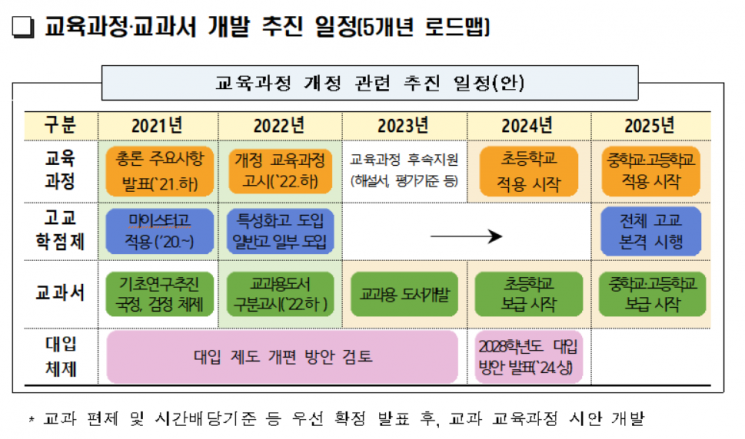
On the 20th, the Ministry of Education, the National Education Council, and the National Association of Metropolitan and Provincial Superintendents of Education announced the implementation plan for the 2022 Revised Curriculum at the Government Sejong Convention Center. The 2022 Revised Curriculum will be applied sequentially from 2024 for elementary schools and from 2025 for middle and high schools. The 2028 college entrance plan will be announced in the first half of 2024.
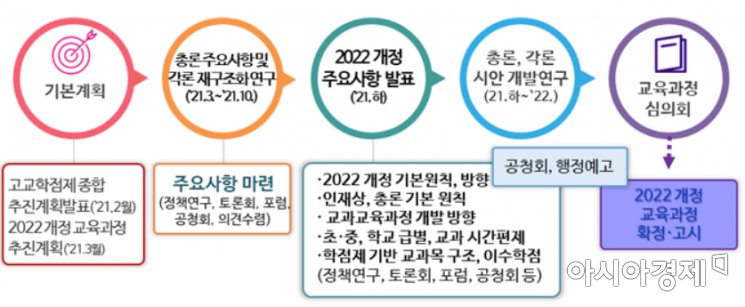
The Ministry of Education plans to announce the main points of the revised curriculum general guidelines in the second half of this year and finalize and promulgate the general and specific guidelines in the second half of next year. Unlike previous curriculum revisions, which were mainly conducted by experts, this time the scope for collecting opinions from students, parents, and teachers has been expanded.
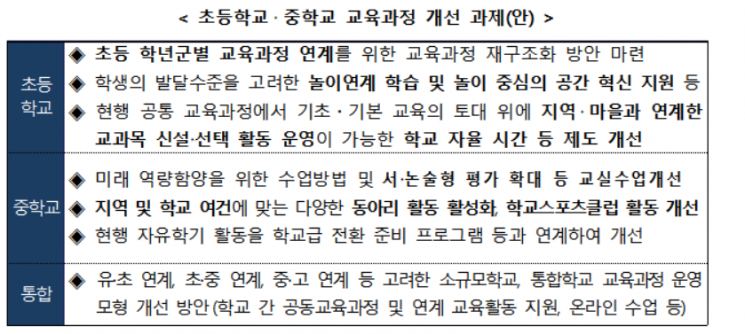
The 2022 Revised Curriculum supports play-linked learning and play-centered space innovation considering the developmental levels of elementary school students. To expand the diversity of the curriculum, the school autonomy time system will be improved to allow the establishment of new subjects linked to local communities and the operation of elective activities within the basic and foundational education of the common curriculum.
For middle schools, classroom instruction will be improved by expanding descriptive and essay-type evaluations. Club activities suited to local and school conditions will be revitalized, and school sports club activities will also be improved. Current free semester activities will be modified to link with programs necessary for school level transitions. Small-scale and integrated school curricula considering connections between kindergarten and elementary school, elementary and middle school, and middle and high school will also be operated.
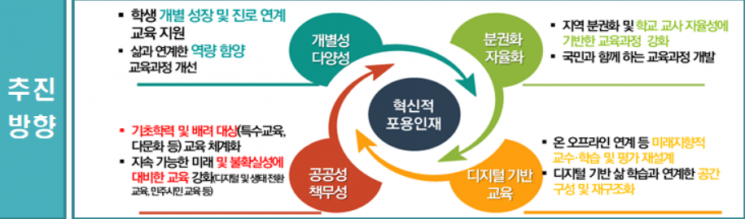
Moving away from textbook and offline class-centered instruction, online-offline linked classes utilizing edutech will also be promoted. The possibility of recognizing remote classes and learning experiences inside and outside school related to subject learning topics as class hours will be reviewed. For example, if students complete training programs and remote class content from accredited institutions in areas such as safety and health education, economic and financial education, and career education, these can be recognized as class hours.
Efforts to expand the autonomy of schools and teachers will also be carried out simultaneously. Autonomy in increasing or decreasing subject hours and restructuring the curriculum will be expanded, allowing free operation of online and offline classes. The creative experiential activity curriculum will also be autonomously organized and operated, with adjustments to guidelines on required hours and operation methods. The transfer of hours between subjects and creative experiential activities will be permitted, and options to link activities with local communities (out-of-school activities) or recognize remote classes according to the characteristics of each activity area will be reviewed.
Future-oriented textbooks linked to the revised curriculum will also be developed. To introduce future-oriented textbooks that align with online-offline linked classes and the high school credit system, plans for developing future-oriented textbooks and the classification announcement for textbooks (state-authorized, certified, and recognized) will be prepared by the end of this year, with sequential development and distribution planned. State-authorized textbooks will be applied from 2024, and certified and recognized textbooks will be applied sequentially from March 2025. They will be applied to grades 1 and 2 in early 2024, grades 3 and 4 in early 2025 along with middle school grade 1 and high school grade 1, grades 5 and 6 in early 2026 along with middle school grade 2 and high school grade 2, and middle school grade 3 and high school grade 3 in 2027.
Efforts will also be made to reform the school life record system and college entrance system to implement the revised curriculum, including the introduction of the high school credit system, as well as teacher training systems as curriculum experts. The Ministry of Education will promote policy research for curriculum revision and collect public opinions starting in April.
Kim Jin-kyung, Chairperson of the National Education Council, said, "Through extensive opinion gathering and discussions, we aim to make this curriculum revision process a nationwide consensus-building process for the future vision of education," adding, "We hope the transition to an open, decentralized, and personalized curriculum will accelerate."
Deputy Prime Minister and Minister of Education Yoo Eun-hye emphasized, "The curriculum is a vessel that can embody changes in schools, and especially the 2022 Revised Curriculum will be the foundation for future education," adding, "Along with the introduction of the high school credit system and the Green Smart Future School, the 2022 Revised Curriculum is a core policy of our education reform. In particular, this revision will be promoted as a 'future-oriented curriculum with the people' by strengthening communication with the field."
© The Asia Business Daily(www.asiae.co.kr). All rights reserved.