Last Year, the Gap Expanded to 73 Million Won
Bukuk Securities, Highest at 203 Million Won
Few Female Executives, Glass Ceiling Persists
[Asia Economy Reporter Gong Byung-sun] It has been confirmed that the profits of securities firms, which recorded record-high performance last year, went more to men. The already severe wage gap between men and women has worsened since COVID-19.
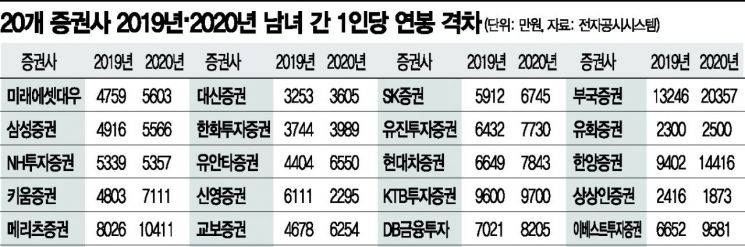
Analyzing the business reports of 20 securities firms disclosed on the Financial Supervisory Service's electronic disclosure system on the 31st, the average annual salary gap per employee between men and women last year was about 73 million KRW. This is about 13 million KRW wider than the approximately 60 million KRW difference in 2019. Among the 20 companies analyzed, except for Shinyoung Securities and Sangsangin Securities, all showed an increased average annual salary gap per employee between men and women.
The company with the most severe wage gap was Buguk Securities. In 2019, men earned about 132 million KRW more per person than women, but last year it increased to 203 million KRW. Next, Hanyang Securities saw the gap widen from about 94 million KRW in 2019 to about 144 million KRW last year. Ebest Investment & Securities, Meritz Securities, Kiwoom Securities, and Yuanta Securities also paid men about 20 million KRW more than women last year.
The wage gap widened even within the same job roles. The average annual salary gap per person between men and women in sales positions at Kyobo Securities was about 15 million KRW in 2019 but more than doubled to about 38 million KRW last year. The retail sales positions at Buguk Securities were even more severe. The gap, which was about 28 million KRW in 2019, grew to about 83 million KRW last year.
Unlike the wage gap, there was little difference in average years of service by job. Investigating the average years of service difference between men and women by job at 20 companies showed a slight increase from about 8 months in 2019 to about 9 months last year. This means that men received higher salaries despite not having significantly longer tenure. In fact, in the previously mentioned sales positions at Kyobo Securities, the average years of service for male employees last year was about 12 years, while for female employees it was about 17 years and 6 months.
Therefore, there are calls for a multifaceted analysis of gender employment in securities firms, including the phenomenon of male dominance as rank rises and employment types. Bae Jin-kyung, co-representative of the Korean Women Workers Association, said, "On the surface, the structure is such that those with higher ranks receive more incentives, but it is difficult for women to rise to senior positions," adding, "We also need to examine whether women in the securities industry are placed in more precarious employment forms."
© The Asia Business Daily(www.asiae.co.kr). All rights reserved.