[Asia Economy Honam Reporting Headquarters Reporter Park Seon-gang] Gwangju Metropolitan City has made old records of Gwangju available on the city’s website under the theme "Memories Going Through Records Gwangju" to allow citizens, exhausted from being unable to go outside due to COVID-19, to travel back in time through records.
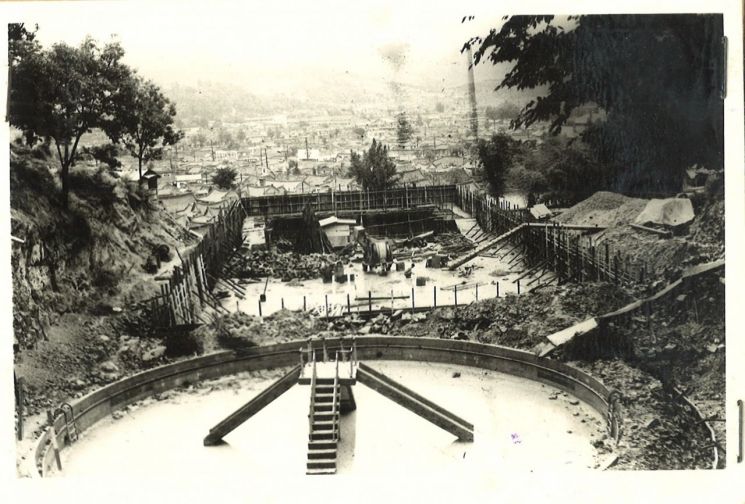
According to Gwangju City on the 8th, the records are historical materials preserved in the city archives. The three records released this time include photos of the pool construction inside Sajik Park Zoo in 1970, a model of the admission ticket, and photos from the opening period of Gudong Gymnasium in 1965.
Sajik Zoo was established in 1971 on the site of Sajikdan in Gwangju Park but was relocated to the current Uchi Park in 1991 following public opinion favoring the restoration of Sajikdan.
The released photos show the pool construction process inside the zoo one year before its opening in 1970.
The admission ticket model also reveals the pool usage fees in the 1970s: adults 100 won, students 50 won, and children 30 won, allowing one entry per day.
Considering that in 1970 the price of a sack of rice was 2,880 won, ramen 20 won, jajangmyeon 100 won, and city bus fare 10 won, playing once at the pool back then was equivalent for an adult to buying five packs of ramen, one serving of jajangmyeon, or taking the city bus 10 times.
It is also possible to learn about the ticket issuance and collection method: tickets were manually stamped by staff upon issuance, and at entry, the ticket gate would tear the ticket to prevent reuse.
Gudong Gymnasium was an indoor sports facility built at the entrance of Gwangju Park in 1965 for the National Sports Festival. It was loved along with nearby gukbap restaurants but has since disappeared, and the Bitgoeul Citizen Culture Center now stands in its place.
The released photos impressively show the appearance of Gudong Gymnasium during the 46th National Sports Festival held in 1965 and citizens dressed in hanbok.
Gwangju City plans to regularly update old records on the city website to encourage citizens to recall the past and to show younger generations how Gwangju looked in the past, with questions such as "Where did Gwangju citizens go for outdoor activities in the old days when there were few recreational facilities like now?" and "The disappeared facilities of Gwangju Park that now exist only in the memories of citizens in their 40s and 50s or older."
Kim Il-yung, Director of the City’s Autonomous Administration Bureau, said, "We will reinterpret and regularly disclose old records preserved by the city to provide opportunities to look back on the various fading images of old Gwangju and to reflect on the importance of history."
© The Asia Business Daily(www.asiae.co.kr). All rights reserved.









![$29 Monthly Subscription AI Plant Appliance... US Startup Challenges LG [CES 2026]](https://cwcontent.asiae.co.kr/asiaresize/319/2026010819285284553_1767868133.png)