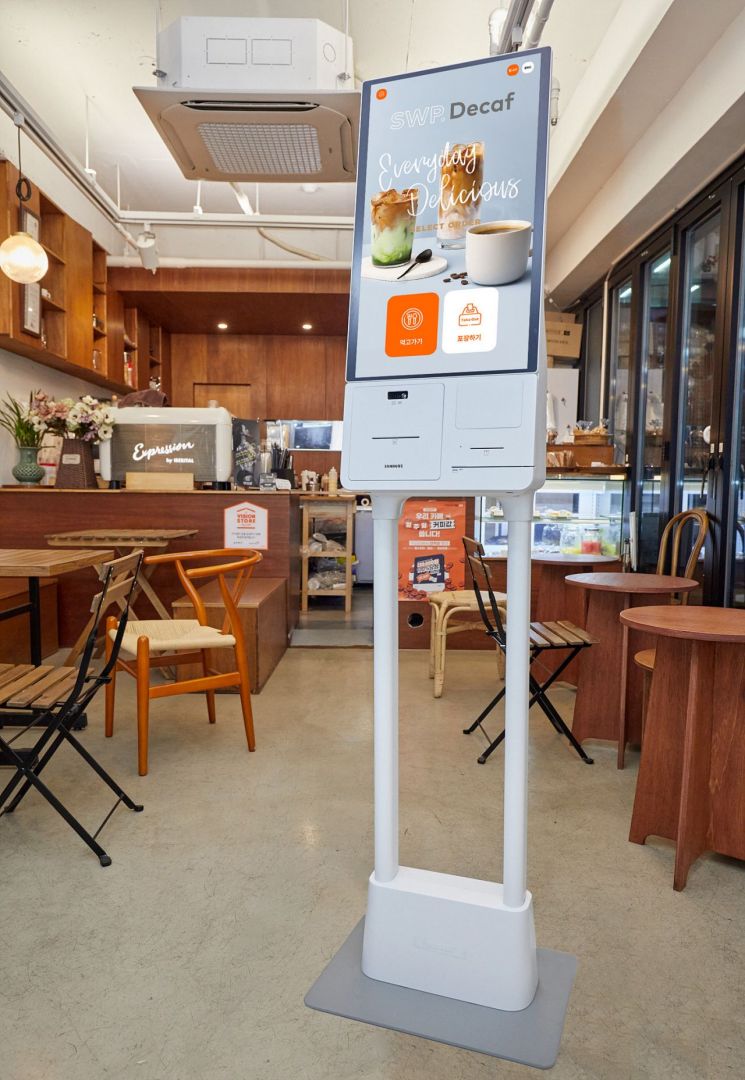
[Asia Economy Reporter Lee Junhyung] As Samsung Electronics enters the kiosk market, the kiosk industry, mainly composed of small and medium-sized enterprises (SMEs) and mid-sized companies, is becoming tense. Although interpretations vary, the industry landscape could change depending on Samsung's moves. Experts have also analyzed Samsung's kiosk launch as a long-term strategy to build payment big data beyond just the market itself.
Kiosk Industry Centered on SMEs... "Too Early to Judge but Monopoly Unlikely"
The kiosk industry is closely watching Samsung's future moves. Most kiosk companies are SMEs and mid-sized firms. The survival of these companies could depend on the strategy of Samsung, a 'mega' corporation.
Among the major players in the domestic kiosk market, Korea Electronic Finance's kiosk sales last year amounted to about 20 billion KRW. A representative from Company A said, "The basic scale difference with Samsung is incomparable," adding, "The kiosk market has low entry barriers, so many companies that used to make POS (Point of Sale) systems have entered."
The industry believes it is premature to judge that the so-called 'kiosk neighborhood market' will be encroached upon, as Samsung's main customers may be large franchises rather than general self-employed individuals. Samsung also stated that the product targets the global market and does not infringe on markets occupied by existing companies. A Samsung official said, "The main target is overseas franchises using expensive foreign products," adding, "It will not overlap with the market targeted by domestic SMEs."
There are also criticisms that Samsung's high-priced products will find it difficult to gain a comparative advantage in the kiosk market, which is structured around custom-made, 'small-lot, multi-variety production.' Samsung's kiosk is priced at 2.3 million KRW per unit, about twice the price of domestic companies' kiosks. It is released with a fixed specification of one type, offering only stand-type or wall-mounted options, so the range of choices is limited.
A representative from Company B explained, "On the surface, it looks like an attractive market, but once you enter, it requires a lot of effort," adding, "Since many companies have already entered the market, monopoly is difficult unless you have considerable competitiveness." He added, "Major franchises have already contracted with companies, so it will not be easy to absorb them as clients before their contract periods expire."
Nationwide AS Network is a Strength... Targeting Payment Data?
Concerns have been raised that it will be difficult to compete with Samsung, which has a nationwide after-sales service (AS) network, given the kiosk industry's need for on-site after-sales management. The official said, "The reason many small businesses exist in the kiosk industry is because entry barriers are low," adding, "Many cases fail to expand business to other regions due to AS issues, so can anyone beat Samsung's AS?"
In fact, Samsung plans to leverage its existing AS network as a competitive advantage. A Samsung official stated, "Existing kiosks were mainly produced in small lots with many varieties, which led to shortcomings in product stability and maintenance," adding, "Besides, there will be demand for high-quality, high-performance kiosks based on Samsung's know-how, including software updates and security technology."
While industry interpretations of Samsung's entry differ, experts predict it could be a foundation for building big data. Payment data is highly valuable as it can predict users' consumption and payment behaviors. Professor Park Sojung of Seoul National University's Business School said, "There is a possibility of expanding into a model like Square, a global electronic payment company that collects small business payment data through POS and expands into various businesses."
Meanwhile, according to the securities industry, the global kiosk market's compound annual growth rate is 17.4%. The U.S. market research firm TMR (Transparency Market Research) forecasted the market size to grow from 1.2 trillion KRW in 2019 to 2.6 trillion KRW by 2027. Considering these statistics are from before the COVID-19 outbreak, the current growth rate is likely higher.
© The Asia Business Daily(www.asiae.co.kr). All rights reserved.