First in Natural History, Cretaceous Dinosaur, Pterosaur, and Bird Footprint Fossils Recognized for Scientific and Technological Value
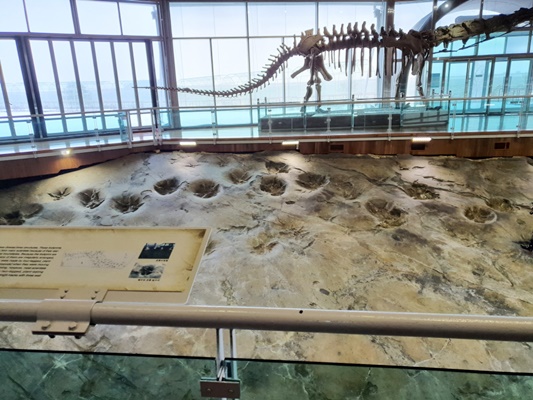 Large herbivorous dinosaur footprint fossils located in Uhwang-ri, Hwangsan-myeon, Haenam-gun (Photo by Haenam-gun)
[Asia Economy Honam Reporting Headquarters Reporter Kim Hyun] Haenam-gun, Jeollanam-do (Governor Myeong Hyun-gwan) announced on the 25th that the ‘Haenam Hwangsan-myeon Uhahng-ri Dinosaur, Pterosaur, and Bird Footprint Fossils’ in Uhahng-ri, Hwangsan-myeon, Haenam have been registered as National Important Science and Technology Data in the second half of 2020.
The National Important Science and Technology Data Registration System has been operated since 2019 by the Ministry of Science and ICT to register, preserve, and manage materials with high historical and educational value related to science and technology that need to be passed down to future generations, thereby enhancing their utilization value.
In particular, for the first time in the field of natural history, the Haenam Hwangsan-myeon Uhahng-ri Dinosaur, Pterosaur, and Bird Footprint Fossils (Haenam-gun·Haenam Dinosaur Museum) and the Sauropod Dinosaur Egg Nest Fossils in Amhaedo, Sinan (Mokpo City·Mokpo Natural History Museum) were registered.
The Uhahng-ri Dinosaur, Pterosaur, and Bird Footprint Fossils provide important evidence that the southern Korean Peninsula was a habitat where dinosaurs, pterosaurs, and birds coexisted during the Cretaceous period.
Estimated to be about 90 million years old, this paleontological fossil group includes webbed bird footprint fossils that are known to be the oldest in the world, predating the Paleogene strata of the Eocene region in the United States by approximately 40 million years, belonging instead to the Mesozoic Cretaceous strata.
Along the coastline, the world’s largest dinosaur footprint fossils (25?30 cm in size) can be found, and more than 1,000 webbed bird footprints are imprinted on the surrounding sedimentary rock cliffs.
Designated as a national cultural asset (Natural Monument No. 394) in 1998, the Haenam Dinosaur Museum, the largest dinosaur-related museum in Korea, was opened and has been operating since 2007.
With the dinosaur, pterosaur, and bird footprint fossils being registered as National Important Science and Technology Data, their rarity as natural monuments as well as their value as scientific and technological heritage to be preserved for future generations has been further enhanced.
Additionally, the Haenam Dinosaur Museum has significantly elevated its status and value as a museum that holds both a natural monument and National Important Science and Technology Data simultaneously.
Governor Myeong Hyun-gwan stated, “The Haenam Hwangsan-myeon Uhahng-ri Dinosaur, Pterosaur, and Bird Footprint Fossils are important natural history materials that show Haenam during the Cretaceous period was a terrestrial paradise where dinosaurs, pterosaurs, and webbed birds coexisted. We will continue to preserve and manage the fossil site to pass on its value to future generations.”
© The Asia Business Daily(www.asiae.co.kr). All rights reserved.