HUG Revises High Price Review System
Allows Pricing Up to 90% of Surrounding Market Value
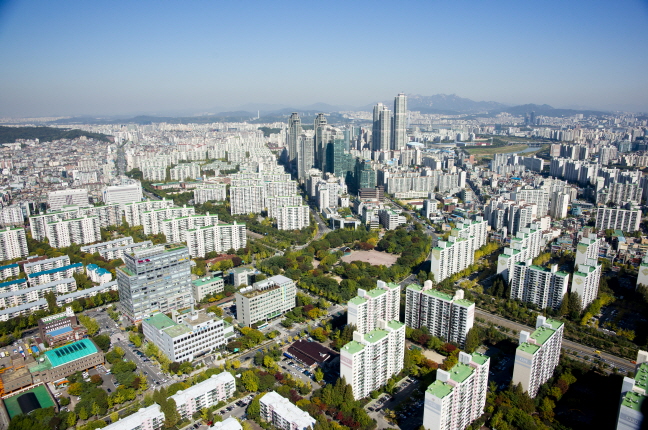
As apartment sale prices in high-priced management areas can now be set up to 90% of the surrounding market prices, it is expected that sale prices in major provincial cities will rise significantly. In particular, concerns have been raised that this measure could cause a price inversion phenomenon between areas subject to the sale price ceiling system and high-priced management areas.
According to industry sources on the 10th, with the improvement plan for the high-priced sale price review system announced by the Housing and Urban Guarantee Corporation (HUG) the day before, the general sale prices of apartments in some metropolitan areas including Seoul are expected to be significantly adjusted upward. This is because HUG decided to consider a certain percentage (85?90%) of the surrounding market price as the upper limit when reflecting it in the sale price review. The high-priced sale price review applies when obtaining a sale guarantee in high-priced management areas designated by HUG. Currently, high-priced management areas are almost identical to government-designated regulated areas.
However, areas where the private land sale price ceiling system is implemented are excluded from the high-priced sale price review. Currently, the private land sale price ceiling system applies to 309 buildings in 18 districts of Seoul (Gangnam, Seocho, Songpa, Gangdong, Yeongdeungpo, Mapo, Seongdong, Dongjak, Yangcheon, Yongsan, Seodaemun, Jung, Gwangjin, Gangseo, Nowon, Dongdaemun, Seongbuk, Eunpyeong) and 13 buildings in 3 cities in Gyeonggi Province (Gwangmyeong, Hanam, Gwacheon), totaling 322 buildings. Accordingly, apartment sale prices in some metropolitan areas including parts of the metropolitan area, Busan, and Daegu are expected to rise sharply, raising the possibility of a price inversion with major areas in Seoul where sale prices are controlled.
For example, in Busan, the price per 3.3㎡ of apartments in popular areas such as Haeundae approaches 40 million KRW, but until now, prices have been controlled below 18 million KRW. However, with the new 90% upper limit applied, sale prices could rise up to 36 million KRW. On the other hand, as of November last year, the average sale price per 3.3㎡ of apartments in Seoul was around 27 million KRW. The Gangdong Millennial Joongheung S-Class, which had a recruitment announcement in July last year, had a sale price per pyeong of 25 to 26 million KRW.
Some predict that relaxing sale price controls will raise the threshold for homeownership, increasing dissatisfaction among actual buyers. Park Won-gap, Senior Real Estate Specialist at KB Kookmin Bank, said, "Allowing an upper limit up to 90% of the surrounding market price may cause sale prices to rise," adding, "From the perspective of actual buyers, the burden of purchasing a home could increase further."
© The Asia Business Daily(www.asiae.co.kr). All rights reserved.