Review Grade-Level Weighting Ratios for 2022 Academic Year Curriculum Screening
Some Departments Reflect Only Top 10 or 4 Subjects by Rank Grade
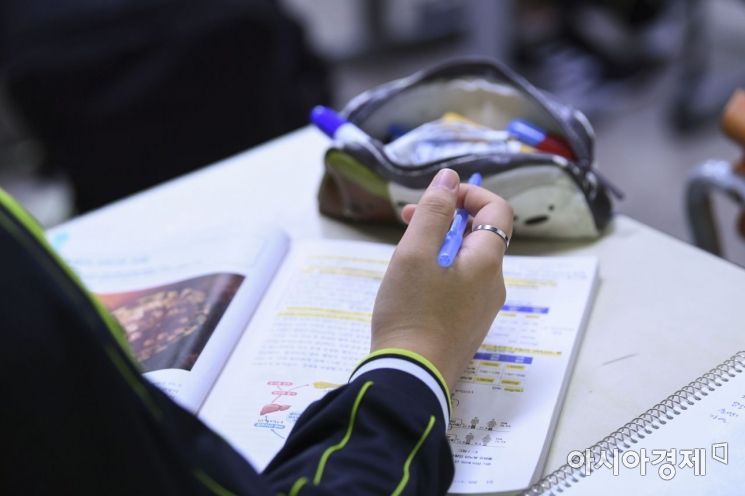 On the morning of the 18th, when the National Joint Academic Achievement Test organized by the Korea Institute for Curriculum and Evaluation was conducted, third-year students were preparing for the exam at Sangam High School in Mapo-gu, Seoul. Photo by Hyunmin Kim kimhyun81@
[Asia Economy Reporter Han Jinju] From the 2022 academic year, most universities except Seoul National University will admit freshmen through the student record-based curriculum screening. This is a good opportunity for prospective high school seniors who find the comprehensive student record screening, which requires many items to be managed, or preparing for the CSAT burdensome.
Checking the Reflection Ratio by Grade is Essential
When preparing to apply through the curriculum screening, it is important to check the reflection ratio by grade. In the comprehensive student record screening, evaluation is qualitative, so if grades improve and the third-year grades are good, a favorable evaluation can be received. In the curriculum screening, many third-year subjects are career elective courses, and there are fewer subjects with grades calculated by ranking.
Korea University and Kwangwoon University reflected grades with a 20:40:40 ratio by grade last year, but from the 2022 academic year, they changed to 100% for all grades. This is disappointing for students who tried to raise their grades in the first semester of the third year to increase their chances in the curriculum screening.
Schools that still apply the ratio by grade this year include Sungshin Women’s University and Seoul National University of Science and Technology. Sungshin Women’s University applies a 30:40:30 ratio, and Seoul National University of Science and Technology applies a 33.3:33.3:33.3 ratio. Even if the number of third-year subjects with grades is small, since the first semester accounts for 30% of the total, current students must do their best until the end.
Which Departments Consider First Semester Third-Year Grades Important?
Even if there is no weighting by grade, the impact of third-year grades can increase depending on whether all designated subjects or only some subjects are reflected. Many universities reflect all subjects in Korean, English, Math, and Social Studies for humanities, and Korean, English, Math, and Science for natural sciences. Some universities reflect only some subjects in those fields. If you get good scores in the first semester of the third year, you can expect some recovery.
Dongguk University’s humanities departments (including Film and Video Studies) reflect only the top 10 subjects by rank grade among Korean, English, Math, Social Studies, and Korean History, and natural science departments reflect the top 10 subjects among Korean, English, Math, Science, and Korean History, without applying credit units. Unlike other universities, although it is a curriculum screening, it reflects 40% comprehensive document evaluation, so the grades and activities in the first semester of the third year are especially important.
Myongji University reflects the grades of the top 4 subjects by rank grade in Korean, English, Math, and Social Studies (humanities), and Korean, English, Math, and Science (natural sciences). If you get good grades in the third year, you can include them in the reflected subjects. Duksung Women’s University divides the curriculum screening into two types: 100% student record screening and teacher recommendation screening. In the 100% student record screening, only the top 4 subjects by rank grade in the top 3 subjects among Korean, English, Math, Social Studies, and Science are reflected. Seoul Women’s University reflects the grades of the top 3 subjects in each of Korean, English, Math, Social Studies, and Science, totaling 12 subjects.
Check Whether Career Elective Subjects Are Reflected

If you also consider the comprehensive student record screening, you should aim to get an achievement level A in career elective subjects. Looking only at the curriculum screening, whether universities reflect career elective subjects should be considered when prioritizing academic work. Many Seoul-area universities do not reflect career elective subjects in the curriculum screening. In this case, you need to pay more attention to subjects where grades are calculated.
Woo Yeon-cheol, head of the Admission Strategy Research Institute, said, "In the third year, many schools operate mainly with career elective subjects, so there are fewer subjects with grade calculations, and many universities do not reflect career elective subjects in the student record curriculum screening. If you have vaguely thought ‘I will work hard in the third year to raise my grades’ while considering the curriculum screening, you should now check how your target universities reflect grades and establish a strategy that suits you."
© The Asia Business Daily(www.asiae.co.kr). All rights reserved.