Improvement Project for 24 Locations Including Shinchon Station Train Underpass
Traffic System Enhancements Such as Lane Securing, Intersection Structure Improvement, and Signal Adjustment Based on Traffic Volume
Improvement Projects Implemented at 25 Locations Requiring Road Traffic Flow Enhancements This Year
[Asia Economy Reporter Lim Cheol-young] Seoul City announced on the 31st that it has collected opinions from district offices, police stations, and citizens regarding locations requiring traffic improvements and has completed traffic system improvements at 24 of these sites.
Seoul City has been improving traffic flow by implementing projects such as additional lane securing and redistribution, intersection structure improvements, and signal adjustments in response to changes in new traffic volumes due to regional development. At the same time, preventive measures have been taken in high-risk traffic accident areas by expanding sidewalks and refurbishing pedestrian islands to enhance pedestrian traffic safety. Road traffic improvement projects are carried out in a way that increases efficiency with a small budget through lane securing by intersection structure improvements and signal adjustments, without new road construction or expansion, which require large-scale budgets and long-term construction.
To improve traffic flow, Seoul City conducted multiple field surveys and expert consultations with related agencies, thoroughly reviewed road conditions, and prepared improvement plans to minimize citizen inconvenience before carrying out the construction.
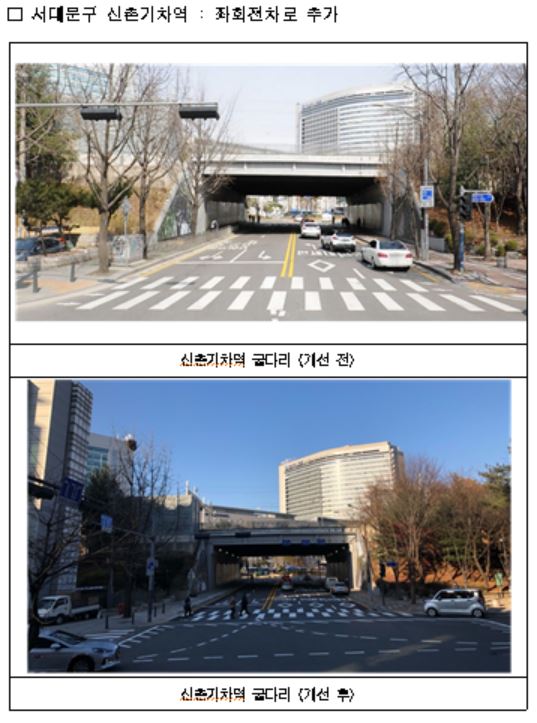
Improvements such as new lane creation, U-turn lane installation, and left-turn lane extension were implemented at 14 locations including the underpass at Sinchon Train Station and Daekwang High School intersection, resolving issues of road congestion and inconvenience caused by using long detour routes. In particular, the underpass at Sinchon Train Station has been used as a detour road since the implementation of the Yonsei-ro “Public Transport-Only Zone and Car-Free Street,” causing habitual congestion. A left-turn lane toward Yonsei University was newly added to relieve congestion caused by concentrated detour traffic. After the improvement, the speed at the entrance of the underpass at Sinchon Train Station increased by 165%, from 2.9 km/h to 7.7 km/h.
At Asia Athlete Village Samgeori, right-turn traffic volume was high, and two lanes with dedicated right-turn signals were operated. However, violations of the right-turn signal during pedestrian crossing signals increased continuously, raising the risk of pedestrian accidents and causing persistent right-turn congestion. Accordingly, the signal system was adjusted and a traffic island was installed to operate only one right-turn lane, improving the situation.
After the improvement, traffic from Jonghap Sports Complex Station to Asia Athlete Village Samgeori improved by 57% (15.7 km/h → 24.7 km/h), and from Samjeon Station to Asia Athlete Village Samgeori improved by 18% (16.8 km/h → 19.9 km/h), contributing to accident prevention and smoother vehicle flow.
At Olympic Park South Gate 4 Intersection, congestion occurred due to increased left-turn demand after the completion of Subway Line 9 construction on Baekjegobun-ro. Seoul City utilized the green space of the central divider to expand the capacity of left-turn and U-turn lanes, resulting in a 22% increase in vehicle speed after construction completion (27.0 km/h → 33.1 km/h).
Ten locations with pedestrian inconvenience and high accident risk due to unreasonable road structures, such as the railroad crossings at Ichon Station and Seobinggo North, were improved to provide a safe and comfortable pedestrian environment. In particular, the railroad crossings at Ichon Station and Seobinggo are on the Gyeongui-Jungang Line ground-level railway, which operates frequently (256?278 times per day), but the crossing width was narrow and there was no separation between vehicle and pedestrian use, causing inconvenience and high traffic accident risk. Seoul City, in consultation with the Korea Rail Network Authority, spatially separated the mixed pedestrian and vehicle passage routes and added traffic safety facilities to secure safe pedestrian passage conditions.
Going forward, Seoul City plans to monitor the improved traffic operation system locations and continuously promote projects to improve traffic flow and prevent safety accidents by reflecting the effects of these projects.
Kang Jin-dong, Head of Traffic Operation Division, Urban Transportation Office of Seoul City, said, "We will continuously promote road traffic flow improvement projects by identifying locations that need improvement through requests from district offices and police stations, citizens’ opinions, and our own investigations," adding, "We will strive to resolve newly occurring traffic congestion and improve unreasonable traffic systems caused by changes in the traffic environment such as housing development."

© The Asia Business Daily(www.asiae.co.kr). All rights reserved.