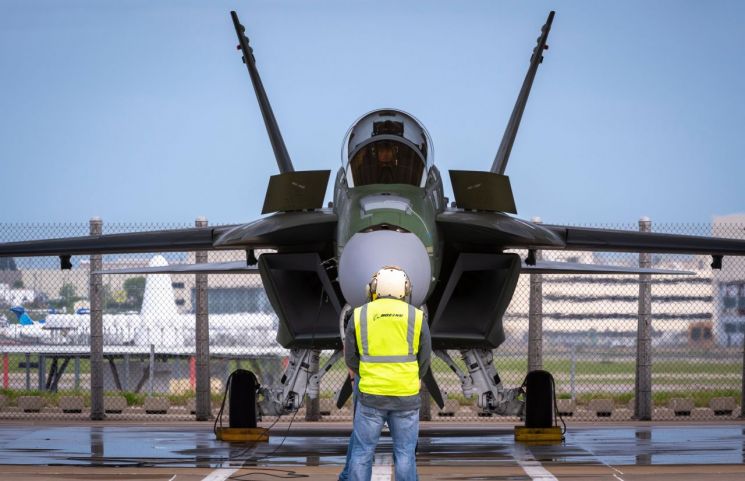
[Monthly Aviation Editor-in-Chief Kim Jae-han] The ultimate version of the U.S. Navy’s main combat aircraft, the F/A-18E/F Super Hornet, has appeared. The latest Super Hornet Block III, manufactured at Boeing’s St. Louis assembly facility, was delivered to the U.S. Navy in June and is scheduled to be fully operational starting next year.
Life Extension and Advanced Equipment Applied = The newly delivered Super Hornet Block III is an upgraded version of the Block II currently in operation. It is a model that extends the service life and incorporates new advanced equipment to prepare the U.S. Navy for future battlefield environments.
Currently, the U.S. military uses upgrade codes along with aircraft designations. This upgrade code, called a “block,” is used when internal equipment and structures are changed without altering the basic mission, and it is indicated after the designation. In other words, the Super Hornet Block III means a model with improved equipment and structure compared to Block II. According to the manufacturer Boeing, five major areas have been improved from the previous Block II.
First, the airframe life has been extended. The original lifespan of the Super Hornet was 7,000 flight hours, but through the Service Life Extension Program (SLEP), it has been extended to over 10,000 flight hours. The airframe structure, which had accumulated fatigue, was reinforced to secure more than 3,000 additional flight hours.
Additionally, the Block III features a newly added “Advanced Cockpit System.” The newly applied cockpit includes a 25.4 x 48.3 cm touchscreen display that allows pilots to easily identify, track, and target multiple threats in various tactical situations. Notably, the touchscreen display technology is also applied in the F-35 fighter jets introduced by the Republic of Korea Air Force.
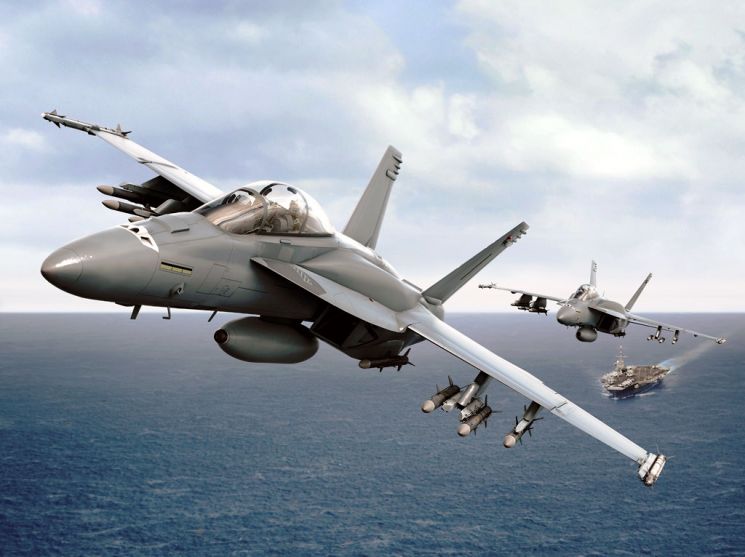
The flight range has also increased. Conformal Fuel Tanks (CFTs), which can carry additional fuel, have been newly added on the upper left and right sides of the fuselage. Designed to reduce air resistance, the conformal fuel tanks can hold about 1.6 tons of fuel, enabling the aircraft to carry more armaments and fly farther compared to the existing Block II.
Moreover, the Block III incorporates fiber optic wiring to support new sensors and armaments, a new targeting processing unit, advanced electronic warfare equipment that enhances electronic warfare capabilities, and an improved AESA (Active Electronically Scanned Array) radar. Improvements have also been made to reduce the radar cross-section (RCS) to minimize detection by enemy radar.
The U.S. Navy plans to procure 78 units of the Block III configuration by 2024 and signed a multi-year contract with Boeing in March last year. It is not yet known whether all 78 units will be newly manufactured aircraft or a combination of newly built aircraft and upgraded Block II aircraft converted to Block III.
Meanwhile, while the U.S. Navy has received two Block III units, the last aircraft produced as Block II was delivered to the U.S. Navy in April. Thus, production of the Block II, which began in 2005, officially ended on April 17 with a total of 322 single-seat F/A-18E and 286 two-seat F/A-18F aircraft produced.
© The Asia Business Daily(www.asiae.co.kr). All rights reserved.