"Even if you get hit and cursed, you can't speak out anywhere"
"Why do young people like the elderly? They all dislike them"
'Elder Abuse Prevention Day' Emotional abuse was the most common last year
Physical abuse involving hitting... neglect and abandonment are also increasing
![[Report] "The Bruise on the Heart Hurts the Most" Sad Twilight, Elderly People Who Are Scolded and Beaten](https://cphoto.asiae.co.kr/listimglink/1/2020061513571295281_1592197032.jpg) On the afternoon of the 15th, an elderly person is sitting in the shade around Nakwon Arcade in Jongno, Seoul, seeking relief from the heat. Today is the "World Elder Abuse Awareness Day," and according to survey results, elderly people are suffering from verbal abuse and physical violence. Photo by Bongju Kim, intern reporter patriotbong@asiae.co.kr
On the afternoon of the 15th, an elderly person is sitting in the shade around Nakwon Arcade in Jongno, Seoul, seeking relief from the heat. Today is the "World Elder Abuse Awareness Day," and according to survey results, elderly people are suffering from verbal abuse and physical violence. Photo by Bongju Kim, intern reporter patriotbong@asiae.co.kr
[Asia Economy reporters Han Seung-gon, Heo Mi-dam, and intern reporter Kim Bong-ju] "They curse, ignore, hit... it's just scary..."
On the 15th, Kim (82, female), an elderly woman met near Nakwon Arcade in Jongno-gu, Seoul, said, "These days, it seems that elder abuse is happening continuously according to the news," adding, "Most of the elderly here live alone. So, I haven't heard about anyone around me being abused, but seeing the news makes me scared because it seems to happen a lot."
She continued, "Elder abuse should obviously not happen," and said, "I live alone, so I don't worry too much about this, but I'm scared that I might be assaulted just because I'm old."
The number of abused elderly people is steadily increasing. According to an analysis based on the operation reports of three elderly protection specialized institutions run by the Seoul city government on the occasion of 'World Elder Abuse Awareness Day' on the 15th, the number of elder abuse reports received in Seoul in 2019 was 1,963, which is 3.3 times higher than the 590 cases reported in 2005 when related statistics were first compiled.
According to the '2019 Elder Abuse Status Report' (hereafter referred to as the report) released by the Ministry of Health and Welfare (MOHW), the number of elder abuse reports last year was 16,071, a 3.8% increase from the previous year (15,482 cases).
Elder abuse usually involves multiple types of abusive acts occurring simultaneously. Last year, cases reporting emotional abuse accounted for the highest proportion at 42.1%, followed by physical abuse (38.1%) and neglect (9.0%).
![[Report] "The Bruise on the Heart Hurts the Most" Sad Twilight, Elderly People Who Are Scolded and Beaten](https://cphoto.asiae.co.kr/listimglink/1/2020061514005895296_1592197259.jpg) On the afternoon of the 15th, elderly people are sitting in a line under a shade in the Nakwon Arcade area of Jongno, Seoul, seeking relief from the heat. Photo by Bongju Kim, intern reporter patriotbong@asiae.co.kr
On the afternoon of the 15th, elderly people are sitting in a line under a shade in the Nakwon Arcade area of Jongno, Seoul, seeking relief from the heat. Photo by Bongju Kim, intern reporter patriotbong@asiae.co.kr
Choi (80), who was sitting quietly near Tapgol Park, admitted to ageism but could not hide his feelings of regret.
Choi said, "It's perhaps natural that young people don't like people our age," and confessed, "Even my own children don't like me."
He added, "My children didn't go as far as to hit me, but they told me to leave the house because they didn't like me. I have three children, but only my son acts like this. I think it's been about 5 to 6 years since I last met my son," wiping his eyes.
He continued, "There really isn't a country for the elderly," and said, "As I got older, I had nowhere to go, so I ended up coming here (Tapgol Park). All my friends who used to play with me have passed away, and since there is nowhere suitable to hang out, I came here."
Voices criticizing young people also emerged. Jo (83), who said he takes the subway daily from Noryangjin in Yeongdeungpo-gu to visit Tapgol Park, raised his voice, saying, "Do you think you will never get old? Young people think they will never age. They hate the elderly without thinking about the future that will inevitably come."
He added, "Where is a place that welcomes the elderly? But when you come here, they give you food and you can meet friends. There is no particular need to go anywhere else. Tapgol Park is a place for old people. But since it was closed due to COVID-19, elderly people with nowhere to go just wander around here," he lamented.
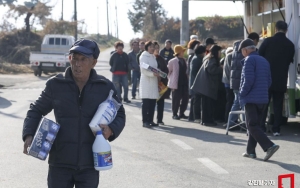
![[Report] "The Bruise on the Heart Hurts the Most" Sad Twilight, Elderly People Who Are Scolded and Beaten](https://cphoto.asiae.co.kr/listimglink/1/2020061514011195300_1592197271.jpg) On the afternoon of the 15th, elderly people lined up in front of a free meal service center near Nakwon Arcade in Jongno, Seoul. Photo by Seunggon Han hsg@asiae.co.kr
On the afternoon of the 15th, elderly people lined up in front of a free meal service center near Nakwon Arcade in Jongno, Seoul. Photo by Seunggon Han hsg@asiae.co.kr
There were also criticisms that poor education on manners toward the elderly leads to ageism, including physical abuse. Kim (74), who said he lives near Jongno 3-ga Station, said, "Education is important to eradicate elder abuse." He continued, "Parents need to educate their children well. For example, from a young age, parents should emphasize 'respect for the elderly.' If the spirit of seniority and respect had been taught from childhood, I think there would have been less abuse toward the elderly," he expressed his frustration.
When summarizing the opinions of elderly people met around Nakwon Arcade in Jongno that day, it turned out that there is practically no space where abused elderly can comfortably open up and talk.
Also, even when verbally abused by children telling them to leave the house, they just suffer in silence without any conditions to improve the situation.
![[Report] "The Bruise on the Heart Hurts the Most" Sad Twilight, Elderly People Who Are Scolded and Beaten](https://cphoto.asiae.co.kr/listimglink/1/2020061514053395315_1592197533.jpg) On the afternoon of the 15th, elderly people in the Tapgol Park area of Jongno, Seoul, sat in the shade to escape the heat. The elderly people interviewed by the Asia Economy reporters on that day were aware of assaults against the elderly but complained that it was difficult to speak out properly. Photo by Bongju Kim, intern reporter patriotbong@asiae.co.kr
On the afternoon of the 15th, elderly people in the Tapgol Park area of Jongno, Seoul, sat in the shade to escape the heat. The elderly people interviewed by the Asia Economy reporters on that day were aware of assaults against the elderly but complained that it was difficult to speak out properly. Photo by Bongju Kim, intern reporter patriotbong@asiae.co.kr
As a result, according to the report, repeated abuse cases are frequent, and especially, 97.8% of abuse occurs within the home.
Analyzing the relationship between abusers (total 5,777) and abused elderly, sons accounted for 1,803 cases (31.2%), and spouses 1,749 cases (30.3%), ranking highest. Combining sons and spouses accounts for 61.5%, with the proportion of spouses increasing every year.
The MOHW plans to strengthen measures to detect elder abuse early and prevent repeated abuse. To prevent economic abuse, such as taking property or rights against the elderly's will, pilot programs like bank account management services and living economy guardian projects will be operated.
Meanwhile, the MOHW is conducting the 'Love Brings Hope' Butterfly Engraving Campaign until the 22nd of next month. Kim Kang-rip, Vice Minister of Health and Welfare, said, "Through the Butterfly Engraving Campaign, we hope people will pay attention to the elderly around them and recognize elder abuse not just as a family or institutional problem but as a social issue," urging active participation.
© The Asia Business Daily(www.asiae.co.kr). All rights reserved.